

As a risk management and automation platform, the meaning behind Parakeet Risk’s namesake bird might not make sense, at least not without a short explanation.
Jowanza Joseph originally sought to build a company that helped people in the Caribbean, so he identified a bird common to the area: the parakeet. While not all parakeet species are native, the small green birds are everywhere. As his company evolved, its name took on added meaning.
Parakeets are very good at imitating. They can copy voices, learn instructions and memorize hundreds of words. Above all, they possess the twin abilities to learn and mimic. And that parallels what Joseph has set out to accomplish.
“We’re building agents that learn from and mimic risk managers,” Joseph says.
AI agents are autonomous software entities that perceive an environment, reason through complex objectives then take actions to achieve specific goals, all with minimal human intervention.
“These agents take tasks inherent to the job of a risk manager, using multiple tools to give a full picture of the risks they’re incurring,” Joseph says. “Any task that can be done with a human in this area, we believe we can do it with our agents, which we call our parakeets. Think of them as a fleet of mimicking birds that will do things exactly how you would want them to.”
An idea is born
Joseph founded Parakeet Risk in 2024, an AI-powered continuous monitoring platform for industrial companies — especially those involved in the manufacturing, logistics and construction sectors — designed to identify, manage and mitigate third-party risk.
After over a decade plus in the tech industry, Joseph had a respectable career, with a resume filled with familiar names like ZAGG, Inc., Adobe and Finicity. He didn’t know it right away, but his journey was leading him toward his true passion.
A light bulb moment happened when Joseph left Finicity for a startup founded by a former boss.
“I realized I had something inside of me to be a founder and start my own company,” Joseph says. “I’d been a founding engineer and an early employee. Neither was being a founder, though. I wanted that all-the-chips-on-the-table feeling, and I started the journey toward finding whatever it was I would put my whole self into.”
A business idea surfaced, thanks in part to his wife. She was connected to many professionals in the construction, manufacturing and industrial sectors. As these were industries he was unfamiliar with, he recognized he was an outsider right away. He spent the better part of 2023 changing that — asking questions, attempting to identify top issues, what they most cared about. In short, how could he improve how they worked?
“I had to learn how to build that culture. I’m not a fluffy guy; I like computers and math. But I can’t deny that where we are now is 100% better than where we were before.”
— Jowanza Joseph
It wasn’t the greatest way to start building a company, Joseph says. He filtered through a lot of answers.
“Writing them all down, though, they took on a common thread, this idea of risk management and risk engineering,” Joseph says. “The industry operates on thin margins and depends entirely upon everything going right. If it does, bases are covered. If one thing goes wrong, however, it could mean company bankruptcy. I needed to build something toward solving that.”
He shadowed risk and procurement managers in construction and management, attempting to better understand their jobs and identifying pain points.
“I could build a product that lowered the cost of third-party due diligence activities and automate it,” Joseph says. “Kind of a three-prong approach: being able to automate getting insurance, identity verification and references.”
The more he researched, the more he learned how financially destructive it could become for companies without implementing a system to keep them in check. For example, a single incident gone awry could cost a company an average of $260,000, with noncompliance fines climbing past $2.5 million. Recovery times were especially lengthy, lasting 18 to 36 months. These stats are echoed on the Parakeet Risk website, any of which could be detrimental to a company’s viability and survival.
A better way forward was needed, and in 2024, Parakeet Risk was born.
A global presence
One of Parakeet Risk’s earliest customers is a large global manufacturer headquartered in Trinidad and Tobago — in the Caribbean, where Joseph’s parents hail from. It regularly employs skilled tradespeople, such as contractors, plumbers and electricians.
With a vast network of over 100 third-party providers, the company needed to constantly collect insurance and liability records. If an electrician were injured on the job and the records were out of date, the company could face extreme liability. The company was stressed, and understandably so.
Parakeet Risk took over the painstaking process of getting every contractor onto its platform. Signing them up. Getting documentation submitted. Tracking insurance statuses. Before they were through, nearly 60 contractors were flagged in various states of expiry.
“Now, instead of this constant process of trying to see if everything is up to date every time someone comes onto their facility, it’s created this heartbeat, where every day they get alerted about possible issues,” Joseph says. “The company has moved from a position of not understanding how much liability was at stake to one where they have full visibility.”
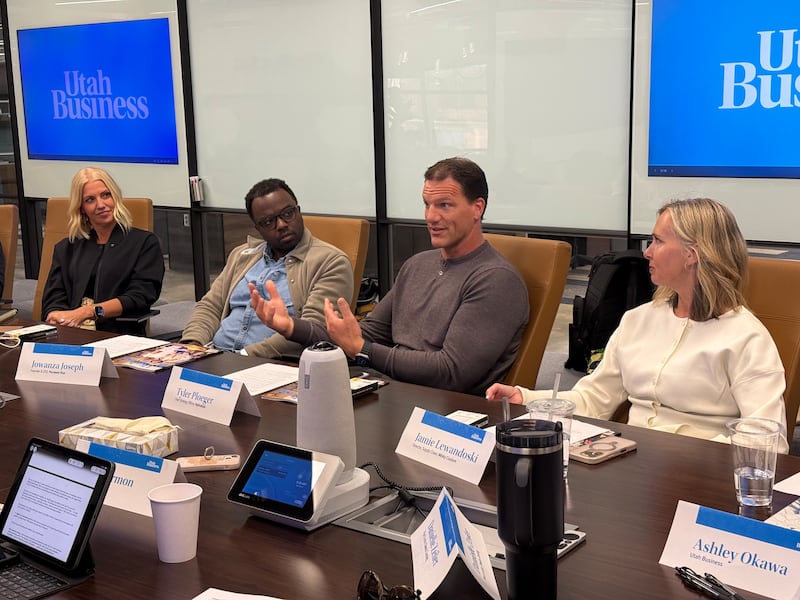
As the only local person on his growing team, Joseph’s company includes employees all over the world, including South America and Europe. One is Andrés Ramos in Monterrey, Mexico. A former logistics software developer, he serves as the company’s lead full-stack AI engineer and product technologist. He joined nearly a year ago, he says, partly because of Joseph’s effective communication and problem-solving skills.
Although Ramos was new to the industry, he was quickly persuaded to make the leap, leaving behind a full-time job of moving cargo all over the world.
“In simple terms, we’re trying to reduce the amount of people that can get injuries and reduce how much money is spent,” Ramos says. “Even though I’d never done this before, I quickly fell in love with the leadership Joseph brings to the company.”
As Parakeet Risk continues to target ever-larger companies within its industry, the number of its own employees is expected to more than double to keep pace with its growth. The company grew from $2 million ARR in its first year to 3x within the second. In 2026, the goals are even loftier, as Joseph plans to go 5x with its growth, up to at least $30 million.
Everyone’s a team player
Having employees who could work with one another successfully was imperative to the company’s success.
“The most important thing you can do is build a harmonious team, one where everyone understands what the end goal is,” Joseph says. “When I built this company, I didn’t spend a lot of time trying to get everyone up to speed on everything that was in play, and I learned that was a big mistake.”
Now there are weekly meetings sharing industry articles, discussing how to demonstrate their expertise and how their product fits, or should fit, into every presented scenario.
“It’s been a game-changer. Now we’re all marching to the beat of one drum. The earlier you can get that to happen, the better,” he says. “I had to learn how to build that culture. I’m not a fluffy guy; I like computers and math. But I can’t deny that where we are now is 100% better than where we were before.”
For all the issues that Parakeet Risk solves and the processes it seeks to improve, its story is also one about purpose, both in seeking and finding it. Joseph understands that.
“This space is a convergence of a lot that I’ve always wanted to do. I found my thing, and I’m obsessed with it,” he says. “Everyone looks for what they want to work on for the rest of their life, and this is that for me.”