

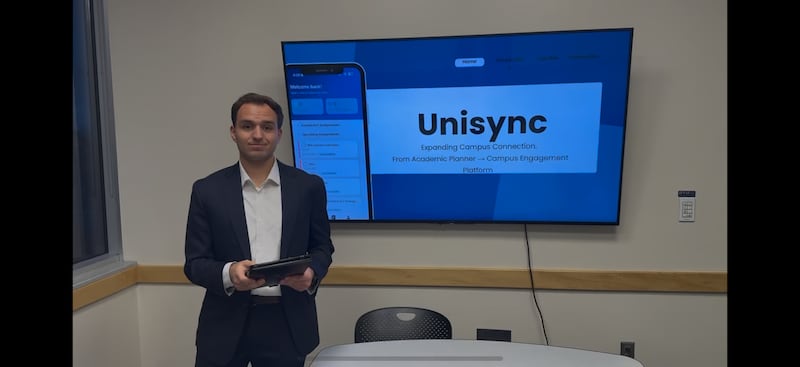
It was Saturday night before winter semester began, and Chris Hoerler was on a call with Apple. UniSync, his app that combines multiple college learning management systems, was supposed to launch on Monday — the first day of classes. He already had flyers across campus, and professors had agreed to send email blasts about the app. Everything was perfectly set, until Apple rejected the app’s latest update from their App Store.
“Apple doesn’t look at [appeals] on Sunday,” Hoerler says. “So I sat on hold with Apple for eight hours one night just to see if our appeals process could be reviewed faster.”
A week later, the app was approved. “We had to recalibrate and rethink our strategy to launch,” Hoerler says. “It was a really hard and stressful week.”
The product worked, and people loved it. On day one, UniSync hit 1,000 downloads.
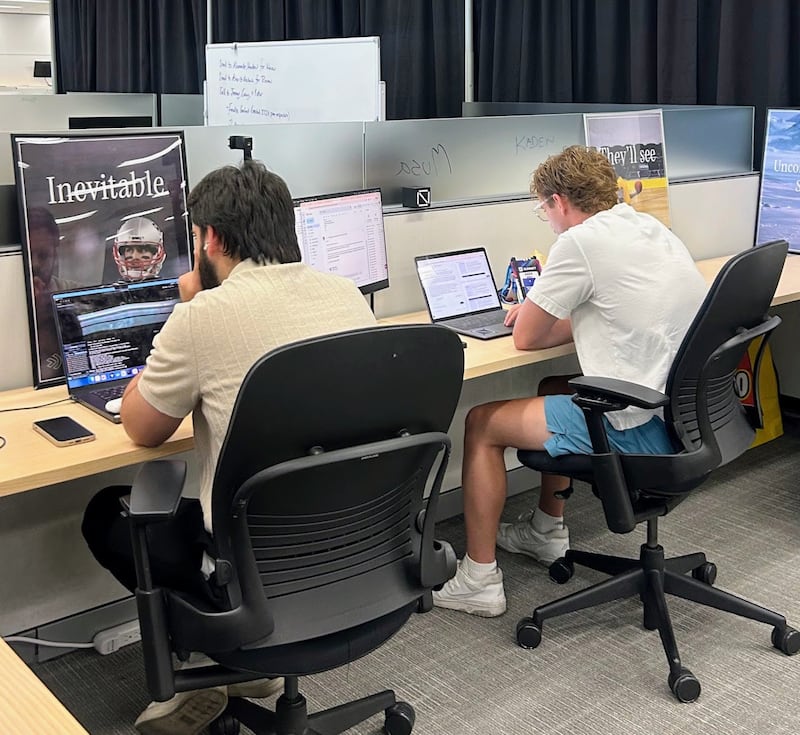
Business-minded students like these are drawn to Sandbox, a student entrepreneurship program that replaces up to 18 credits of a student’s senior year with building a real company. It started when Brigham Young University faculty asked Chris Crittenden, a BYU professor at the time, how to increase student job placement in product management roles. Rather than teaching students about the skills for the job, his answer was to provide students with real-world experience through building their own startups.
“My fundamental belief is that education should be hands-on,” Crittenden says. “Not class projects. Real work, real stakes, real outcomes, real teams.”
As a result, Sandbox was started. Instead of sitting in classes and reading business cases, students face real-world problems and figure out how to build something from scratch.
“They’re not just coming up with a business model and doing things in theory in a classroom setting,” Crittenden says. “They’re actually going out talking to real customers, doing sales and shipping real products that real customers pay for and use.”
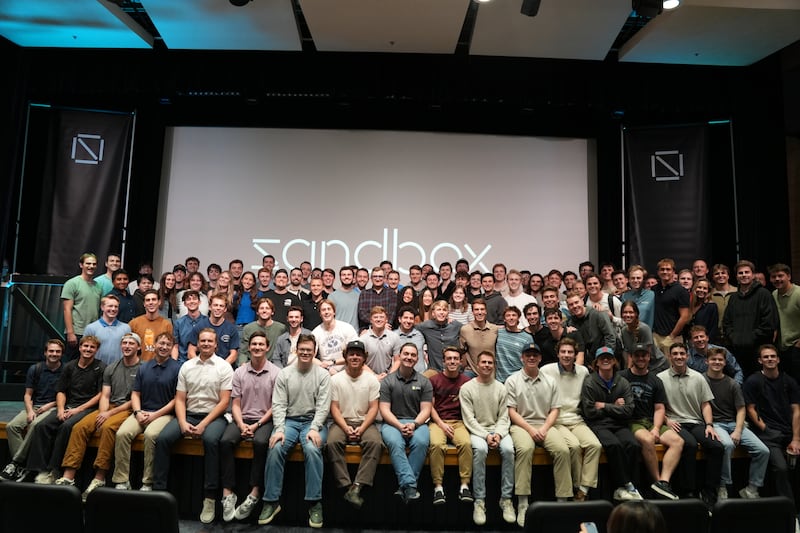
Since launching at BYU in 2020, the program has expanded to eight universities across four states, including Boise State, Northern Arizona, Utah State and the University of Louisville. This fall, it arrived at the University of Utah through a partnership with the John and Marcia Price College of Engineering, the College of Science, the David Eccles School of Business, Lassonde Entrepreneur Institute and the Doman Innovation Studio.
From the beginning, Sandbox has shown positive results. Sandbox companies have raised outside funding collectively valued at $262 million. Six Sandbox startups have been accepted to Y Combinator, one of the most prestigious startup accelerators in the country. Even founders who don’t continue their startups post-graduation tend to earn $15,000 more in starting salary than peers who have never participated in the program.
Launch now
Weston Burnett and Baylor Jeppsen are in the Sandbox master’s fellowship building Struvia, an AI-powered estimation tool for general contractors.
Before Struvia, their first company was a wedding startup built during the undergraduate Sandbox program. It ran for almost 18 months. But they found themselves in a competitive market that didn’t have many paying customers.
“We weren’t growing really fast, and it’s cutthroat in Utah,” Jeppsen says. “If we’re going to do a startup full-time, we need to launch in an area where people are willing to move fast.”
After their first venture, co-founders Burnett and Jeppsen pivoted to the construction space. They started cold-calling contractors, pitching ideas and listening. According to an industry contact, the biggest problem in construction is a labor shortage. To validate that need, they called contractors to test the theory. What they found was a different bottleneck, and an opportunity to fill a gap in the market.
“The real problem was estimation and preconstruction,” Burnett says. “So that’s how we got to where we are.”
Sandbox gave Burnett and Jeppsen a place to learn from their first startup and carry the lessons into the next one. Within the program, it became the foundation for what comes next and has empowered them beyond their business.
“It’s changed our lives,” Jeppsen says. “Not just from a business standpoint, but from how I think about who I am and how I want to live. Just go do that thing you’re interested in trying to do, and if it works, great — and if not, you learn something.”
‘Cougars don’t cut corners’
Fritz-Carl Morlant has started multiple companies while still a student at BYU — from a translation app for refugees to a clothing brand for humanitarian causes to a VC-funded startup in Sandbox.
Now he’s building Altruvia, an AI-powered platform for nonprofits, with the first beta deployed in January. Each venture taught Morlant something that required real-world experience to learn. Early on, he assumed his co-founders would meet deadlines the way his classmates do. But what he found was that his co-founders were struggling to meet these deadlines, and it damaged customer trust when deliveries weren’t coming on time.
“Businesses are people,” Morlant says. “Choose the right people. You have to make sure you have values that align.”
He has found that bringing on team members he trusts completely has changed his experience. “That’s what has been making Altruvia successful,” he says.
AI has been a major driver of growth in the startup space. Morlant also pushes back on the perception that Gen Z uses AI to take shortcuts. “Our team — the reason we call it a research and development company — is that we’re not trying to take shortcuts,” Morlant says. “We can’t just throw AI at a problem. We have to fix the whole thing.”
Hoerler sees the opportunity to build similarly. After 1,000 downloads of his UniSync app, he quickly ran into a problem, which was his customers were broke college students. He hasn’t made a dollar, but he hasn’t cut corners and has zero regrets.
“We haven’t made a dollar off this product,” Hoerler says. “But the learning experience we’re getting out of it is almost more valuable than any class we’ve had at BYU.”
A new approach to higher education
There are about to be fewer college students in America. Undergraduate enrollment in America fell 15% between 2010 and 2021. Only one in four U.S. adults say a four-year degree is extremely or very important to obtain a well-paying job today, according to Pew Research. University closure rates are projected to increase in the coming years.
The causes of the college enrollment cliff come from multiple drivers. Lower birth rates and rising costs have been cited as reasons, but at the heart of all of the factors is the question: Does a degree return enough value to justify the time and money?
Sandbox is one response coming out of Utah, though it might not be for everyone.
“Sandbox is not the easy way out of school,” Crittenden says. “It’s the hard way out.”
His vision is to transform universities by providing hands-on experience to set students up for success. According to research from the National Association of Colleges and Employers, students who participated in hands-on and experiential learning receive better outcomes after graduation in terms of salary and job opportunities.
“We deeply believe in Sandbox that college campuses are magical places,” Crittenden says. “Putting 30,000 young people in one place just creates a special kind of energy.”
Crittenden remains optimistic about the future of higher education. “There are colleges closing every single year. I think we can fix the challenges colleges are facing so they can live on and continue to exist.”
