
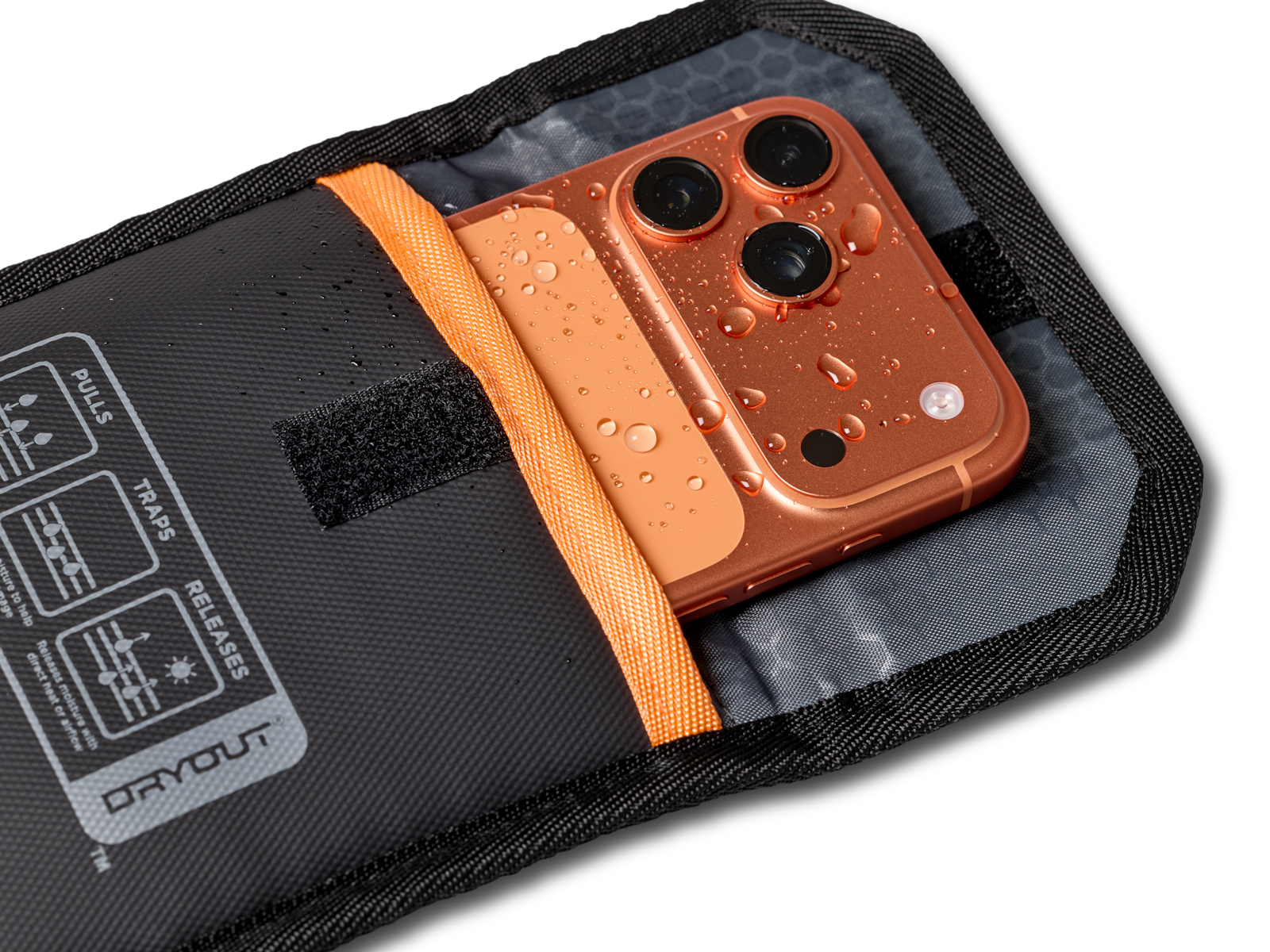
Elliot Harris drenched his iPhone while washing his fishing boat.
Panicked, he rushed to Best Buy looking for a way to save his tech and his wallet, but the best solution the employees could provide was a bowl of rice. He tried it. It didn’t work. He was out $1,200.
A few days later, Harris found himself wearing a moisture-wicking workout shirt while eating a bag of beef jerky. At the bottom of the bag, his fingers found the silica gel packet that holds moisture and prevents food from molding. This was his lightbulb moment.
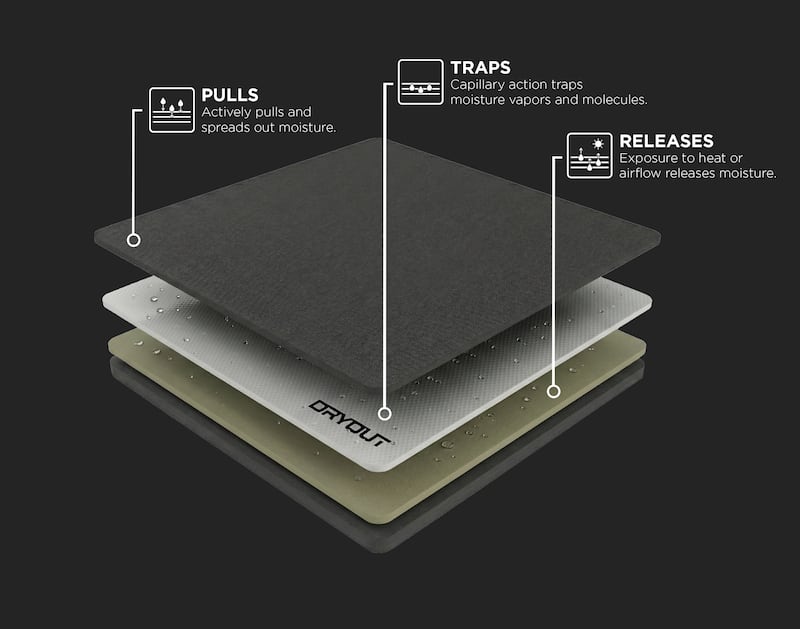
Harris immediately thought of his phone trouble and couldn’t help but wonder if a pouch made of moisture-wicking fabric and silica gel could have saved him. Without any formal product design training, Harris created and patented the wet electronics rescue pouch. The pouch pulls moisture from devices, traps it and releases it when later exposed to sunlight, controlled heat or airflow.
Harris started two companies — Absorbits and BONE-DRI — to sell his new technology. Absorbits focused on the wet electronics rescue pouch, and BONE-DRI created gun sleeves to help protect firearms from rust and corrosion. A few large business deals came in, so Harris invested in building an inventory.
Soon after, the world went into lockdown due to the COVID-19 pandemic and all sales were driven online. Harris, having little e-commerce experience, knew he had an amazing product, but he needed help getting it to the people who needed it. He joined startup accelerator RevRoad as a portfolio company and met Romney Williams.
Williams did his undergrad in Utah, developing an “insatiable appetite to lock arms with smart people and build something special,” he says. After school, he joined an MIT spin-off company that had invented a CMOS image sensor, a digital imaging sensor that would initially be used in digital cameras and eventually exist everywhere: cars, computers and phones.
“They were an ingredient brand similar to Intel inside a computer or GORE-TEX inside a ski jacket,” Williams explains. “That was our business model.”
The experience led Williams to join three more companies as CEO or president. At the beginning of the COVID shutdown, he was looking for his next role and was introduced to Derrin Hill, co-founder and CEO of RevRoad. Hill learned about Williams’ history of partnering with founders who have visions to disrupt major industries but don’t necessarily want to be CEOs. Naturally, Hill immediately told Williams about DRYOUT.
“When I met Elliot and learned about the technology, … the vision I saw for the company was: don’t carry inventory, don’t try to convince people they need it. Adopt this ingredient-brand strategy, an OEM [Original Equipment Manufacturer] business model, similar to GORE-TEX, selling to Arc’teryx and North Face and Patagonia,” Williams recalls.
Now the CEO of DRYOUT, Williams successfully transitioned the brand from a direct-to-consumer model and is excited to announce upcoming partnerships with Pelican Products and UAG, where DRYOUT technology will be a core ingredient in new products.
“[UAG is] doing a phone rescue pouch. What’s really cool about that is literally the founding story was a phone pouch,” Williams says. “The fact that we have a tier one brand that sells in Best Buy, launching a fully enhanced version of it is really exciting for us.”
Support breeds success
When Williams joined the company, it was bleeding cash, struggling to offload inventory. Although he knew how to build the company into an ingredient-based business and was confident in its success, the inventory overhead was constantly shrinking the runway and cash flow. The situation was dire — and stressful.
Eventually, Williams called a board meeting to pitch his vision, asking Harris and the board for their full support to continue.
“The board was amazing. They said, ‘We agree, but figure out how to sell this inventory,’” Williams says. “I had a very supportive and patient board and very patient investors in those early years.”
Even more importantly, Williams had the support of his spouse. “If you have a spouse or a life partner, … make sure that you are aligned,” Williams advises, saying it’s vital to have open and honest conversations about what risks you and your family can and are willing to take.
“[We will be] partnering with, hopefully dozens, if not hundreds, of brand partners around the world.”
— Romney Williams
Williams’ wife has encouraged him through his entrepreneurship journey. During one of the more challenging times at DRYOUT, she worked full-time for a year for the company without pay.
“She just said, ‘Romney, it’s not about the compensation. Obviously, it would be great if either of us could get paid, but I believe in you and in the vision and in the technology and in the opportunity, so I’m happy to help,’” Williams recalls. “It truly was a moment where I felt very, very fortunate. I would have cracked if I had been on my own.”
Thinking inside the box
To shift DRYOUT’s trajectory toward becoming an OEM, Williams began meeting with CEOs and companies he thought would be a good fit. Through the process, DRYOUT partnered with the University of Utah’s chemical engineering department to conduct third-party performance testing on the product. The partnership provided insights to the company, but even more confidence to future partners and buyers.
Williams also began conducting customer surveys, finding that 79% of people in America reported an issue with a phone getting wet. These and other statistics further illustrated the product’s value.
The final evolution came when Williams realized production time was keeping partners from jumping in. He quickly decided to offer turnkey product design, product development and production oversight to DRYOUT’s customers.
Having data and information at the ready when meeting with new partners allowed Williams and DRYOUT to build the offering’s framework. With all production services covered, prospective companies ran wild with the possibilities of applying DRYOUT technology. Saying “yes” was easy.
“The marketing was more engaging in conversations with brands. CEOs had their product, [and we could say] ‘Here’s what’s possible with this technology. How could it apply to your world?’” Williams says. “Speed to launch is really important. We always want to shorten that path.”
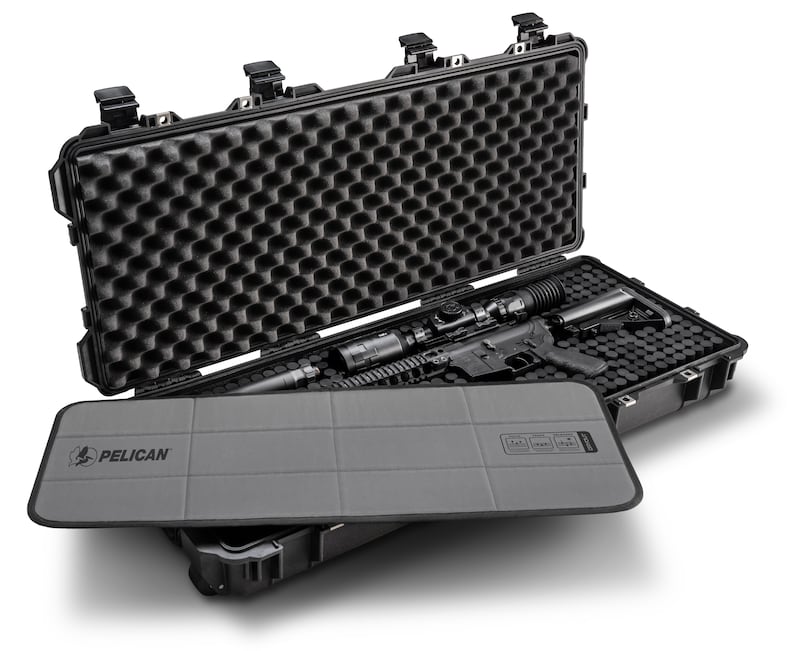
These efforts have brought on upcoming partnerships with Pelican Products and UAG, with many more companies waiting in the wings. Williams says his goal for the company is to be in every household in North America by 2033. With him at the head and Elliot serving on the board, DRYOUT’s direction has never been clearer.
“I wouldn’t call it a pivot. I’d call it an evolution or graduation from a consumer product company to being an ingredient brand,” Williams says. “[We will be] partnering with, hopefully dozens, if not hundreds, of brand partners around the world.”