

It’s a short video: just over two minutes long, and no clip is more than a few seconds. Subjects pluck grapes off a stem and hold their phone. One man pets his dog, and another holds his wife’s hand.
What makes these innocent tasks incredible is that each subject is an amputee, and they are using a revolutionary bionic hand capable of using the brain to send and receive signals like a real hand.
Biologic Input Output Systems (BIOS), in collaboration with researchers at the University of Utah, has spent years and more than 30,000 hours of human data to develop the limb. Josh Miller, CEO of BIOS, says they are 18 to 24 months out from the arm being available for patients 18 and older, but they’re already thinking about further applications of the technology.
“First it’ll be for upper arm loss, followed by lower limb, then partial hand and partial foot,” Miller says. “And then we want to get into other clinical use.”
No longer science fiction
Since the invention of prosthetic limbs, hands have progressed very little. Patients traditionally have the choice of passive or body-powered options. Existing bionic options seemed promising, but with muscle-activated operation, they were prone to moving at unwanted times and slowly.
Amputees and experts in robotics, medicine and technology have long dreamed of a day when limbs would be as advanced as the one Luke Skywalker receives in “Star Wars.” BIOS gets them closer to that dream than ever. Their technology, paired with an advanced robotic arm — aptly named LUKE or Life Under Kinetic Evolution — eliminates these issues by interpreting brain signals sent to the nerves instead of muscle flexing.
“We take these analog signals that come out of your brain … and we translate that in real time into a digital signal,” Miller explains. “Then we can translate digital signals going back upstream, so people not only control the limb but they also gain sensation.”
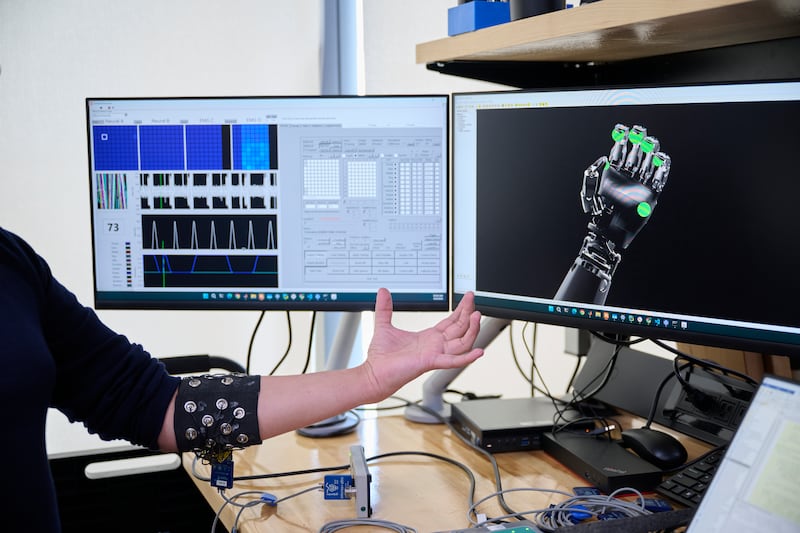
Marshall Trout, a postdoctoral research fellow at the Scientific Computing and Imaging Institute at the University of Utah, displays the labs for the testing and development of the arm. He shows the chip used to translate the signals, which is implanted near the patient’s shoulder. It’s small — hardly the size of the nail on a pinkie finger, but it is capable of reading and sending brain signals to and from the arm in just 10 milliseconds.
This time is a fraction of the 30-millisecond standard researchers use to measure how quickly the human brain communicates, Trout says. Any slower, and there is a noticeable delay. The speed is thanks to a custom AI that is capable of handling massive amounts of data quickly. It’s not a large language model, but trained on the body’s electrical signals.
“We know it works. So now we’re just going through the regulatory piece and the reimbursement piece,” Miller says.
Miller also credits a portion of the success to Utah, both its researchers and entrepreneurial environment. He says the Governor’s Office of Economic Development has been incredibly helpful, and Utah has the potential to be “the Silicon Valley of neurotech.”
Limbs and applications beyond
The potential applications of technology that can interpret and intercept the brain’s signals to the body are almost endless. Several aspects of medicine could be impacted, including pain management and lowering the need for surgeries to implant medical devices like pacemakers, which Trout points to as an example. It may even give doctors more precise insight into what the body is trying to say.
Miller believes the next wave of medicine will see more personalized and fine-tuned treatment.
“Hopefully, brilliant doctors and clinicians around the world will find a use for this ability to read and write the data, like, what is the brain saying to your kidney? What does your kidney say to your brain?” Miller says.
In a world where prosthetic limbs have settled for “good enough” for more than a century, Miller believes this leap forward shows that a near-normal quality of life is possible and worth striving for.
“Rather than giving people enough to get by, you’re going to be more focused on restoring complete functionality and complete quality of life. And I hope it’s a really bright, exciting time for people.”
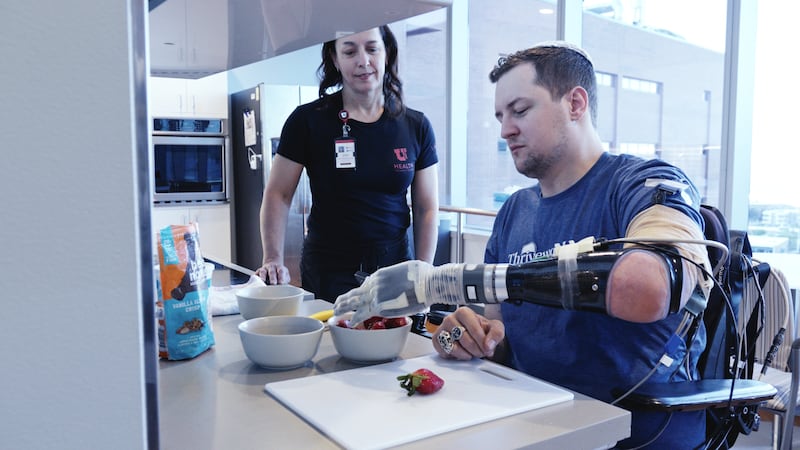
The last clip from the bionic hand video — the older man holding his wife’s hand for the first time — made an imprint on Miller. He’s constantly reminded not to take these small things for granted and that the work from BIOS and the University of Utah makes a personal, emotional difference.
“We don’t talk about profit margins; we don’t talk about net revenues,” Miller says. “We talk about how to get this to people as fast as possible. It’s a really, really rewarding thing to be a part of.”
