
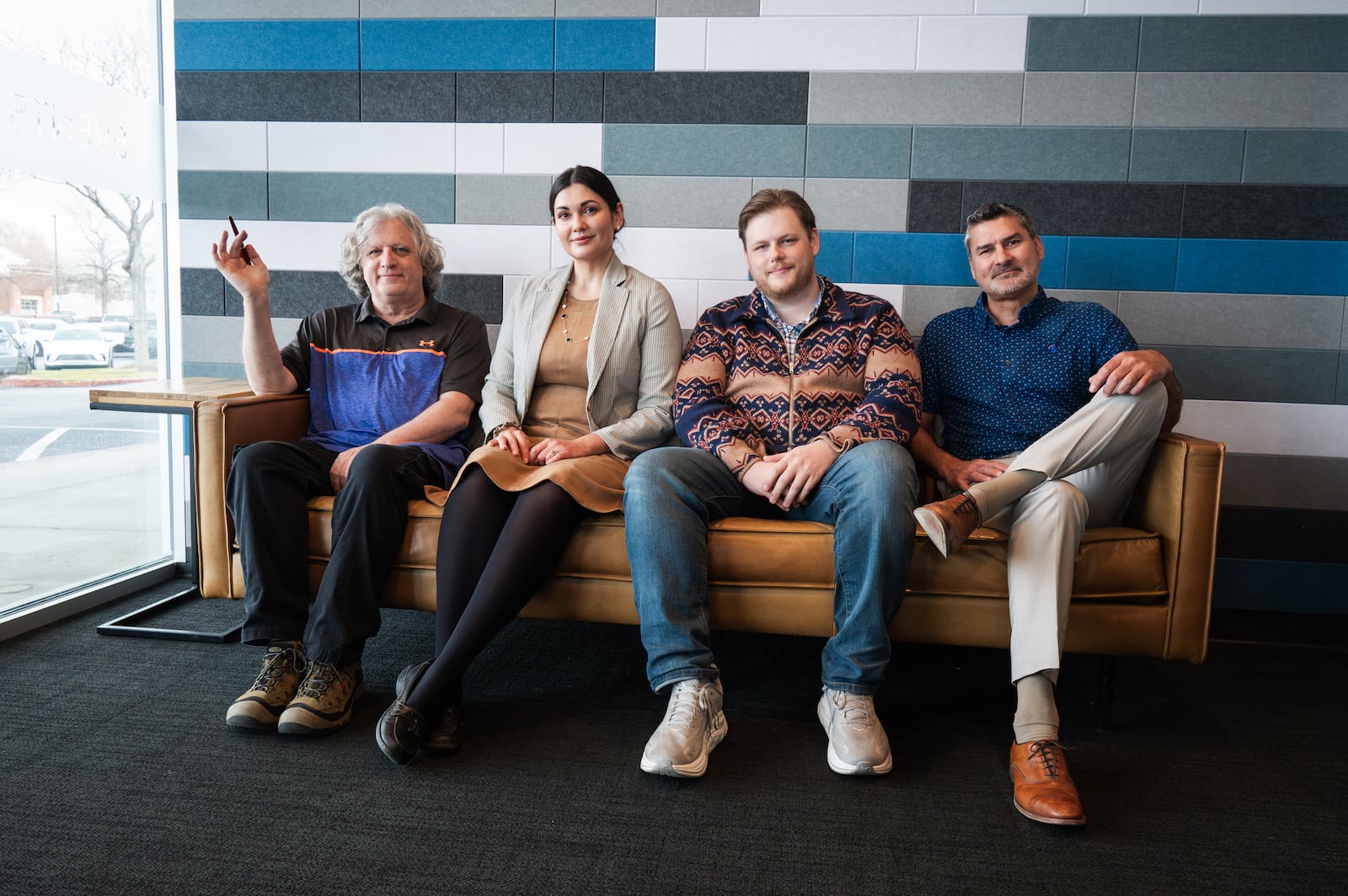
Artificial intelligence is the headlining technology of the 2020s, but for Alexandra Pasi, it is the culmination of decades of work across industries and companies, and what she has spent more than a decade of her own career understanding.
Pasi has been studying AI and machine learning since 2010, long before ChatGPT made AI technology a household name. Over that time, she has watched the field become increasingly dependent on this formula: more data, more computing power and bigger models.
Pasi knows there is another way.
Her Ph.D. in mathematics from Baylor University primed her to break algorithms apart. Upon finishing her doctorate, she accepted a corporate role, where data analytics and consulting showed her the limitations of modeling.
That work brought her back to a few fundamental questions. How much information does a model need? How quickly can it process that information? What must it sacrifice to produce a reliable answer? Across use cases, Pasi kept encountering the same trade-off.
“Both AI and ML (machine learning) have been held back by either efficiency, accuracy or both,” she says. “This has been a well-known trade-off: If you want something more efficient, it will be less accurate, or more accurate and less efficient.”
From loan and investment simulations to trial tests, Pasi says the AI systems she studied were missing the mark.
The limits of scale
At the root of many current AI systems, including LLMs (large language models), are neural networks: layers of interconnected nodes that process data and learn patterns.
“This method relies on a bunch of training data,” she says. “They’re learning all of these simple, local patterns around tracing points, then trying to connect all of the dots.”
With many dots, a clear picture is easy. But if the dots are limited, far away, or in the wrong place, that picture becomes fuzzy.
“Machines in this instance aren’t able to generalize well, especially in novel situations without much data to support,” she says. “The answer until now has been to throw as many data points into as many computers as we can and hope that the pattern is extracted by scale.”

The effort in running a system like this is immense: trillions (or more) parameters are decoded and either connected or discarded. That’s further complicated when its outputs are clearly wrong.
“If you’re building a medical model, the accuracy and reliability are especially important,” she says. “But an LLM, it’ll draw on your research just as much as a ‘Grey’s Anatomy’ episode to make connections.”
Teaching machines to find rules
This puts a huge burden on companies to gather and store data, exposing it to breaches or misuse. Rather than flood frameworks with data points, Pasi and her team decided to train the algorithms to think differently.
“Physicists find laws that describe patterns, and then extract or reconstruct the same degree of information without having to record all of the atoms in the universe,” she says. “We’re doing that for ML.”
This approach harkens back to a Soviet school of machine learning in the late 1990s.
“The algorithm is trying to learn what points are similar to each other in the sense of whatever question we’re asking,” she says. “Both very cold and very hot temperatures will result in low crop yields. From that perspective, the extremes are similar — geometrically, you can think of that as a line.”
The insight that every problem has unique geometry is not new, but the ability to train a machine to find it is.
“[Lucidity Sciences] produced a better mathematical framework that can extract the geometry from the math without solely relying on data dumps,” she says. “These machines can now find rules from unique data sets and then follow them.”
“We have an inference speed a thousand times faster than other solutions, all with better accuracy.”
— Alexandra Pasi
Putting Lumawarp to the test
Just like the laws of physics, once the patterns are identified, they can be tested.
That is what Lucidity Science’s product Lumawarp does: identify patterns in data to create faster throughlines. The result is more accurate machine learning that isn’t weighed down by quantity.
One of Lucidity’s Utah-based clients, Azunic, said it could not have accomplished its work without Lumawarp.
“Azunic is … fully replacing animal testing in preclinical trials by using in silico human data and live biological human organoids,” says Azunic CEO Jerry Henley. “This has been accomplished through the great computational capabilities enabled by Lumawarp. Lucidity offers a computational way of giving us critical answers on terabytes of data more efficiently than any machine learning platform we’ve ever seen.”
The kicker? It’s cheaper than other models on the market, while still being faster and more accurate.
“The size of our model doesn’t increase with the size of the data set, so we can compress storage costs by hundreds of times,” Pasi says. “We have an inference speed a thousand times faster than other solutions, all with better accuracy.”
Lucidity’s lack of compromises has thrown any trade-offs out the window. “With us, you can be at the leading edge of AI without risking anything,” she says. “Lumawarp makes the sky the limit.”