
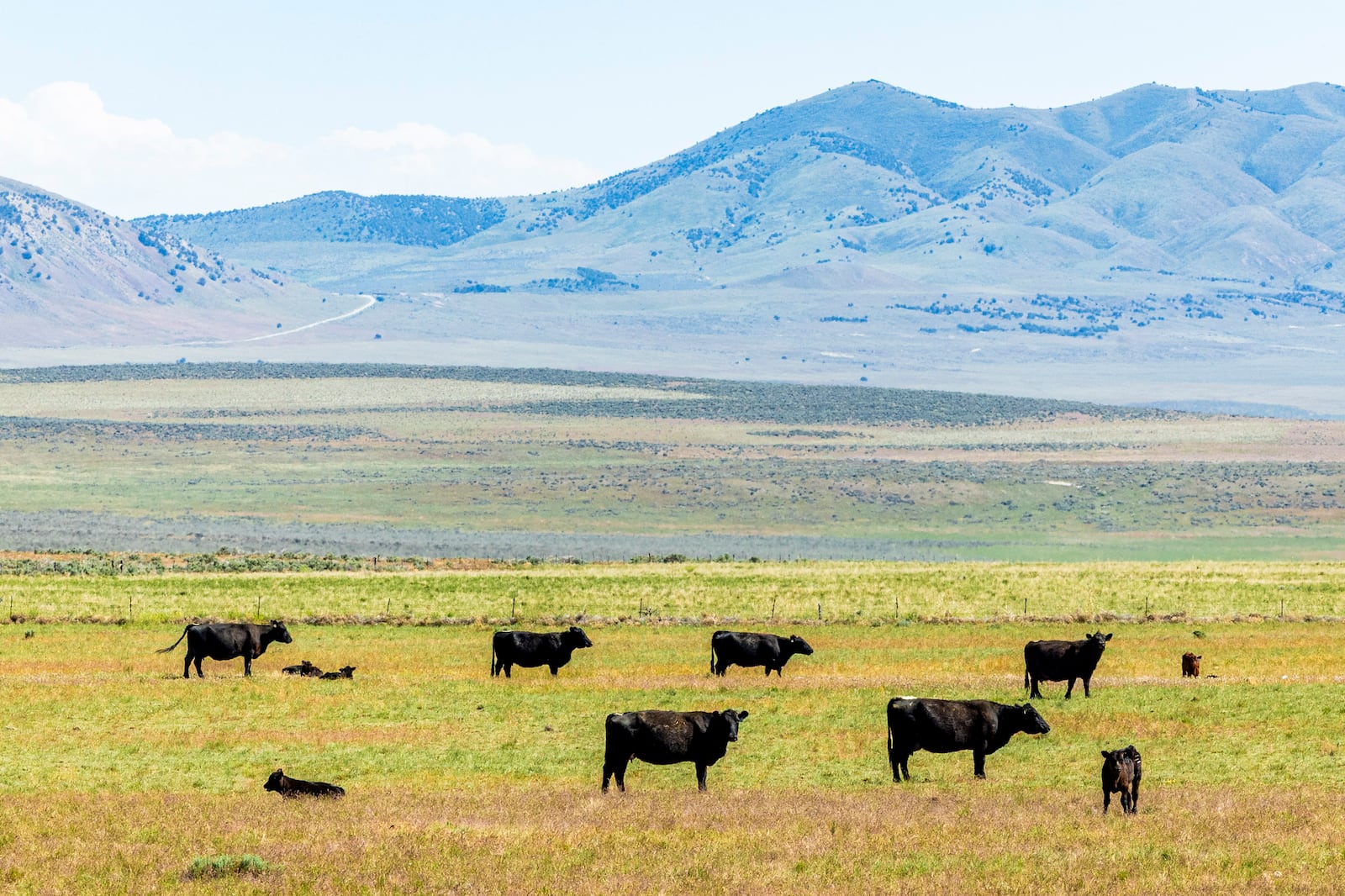
Joel Ferry, executive director of Utah’s Department of Natural Resources, understands the development of AI as the current era’s space race. In the 1970s, Box Elder County became linked to NASA’s space shuttle program; now, Ferry believes the county could play a pivotal role in international geopolitical posturing.
With the advancement of a planned data center in the county — originally proposed to be more than twice the size of Manhattan before being reduced by half — Box Elder residents are weighing in on whether they want to house such a project. For Ferry, who lives in Box Elder County, the project represents a “new race.”
“When you look at what’s out there, with the advancements that are being made by foreign adversaries — China, Russia, others — who may not have a free society, Western mindset,” Ferry says. “This is our opportunity to participate and advance and show our ability to perform and to win this space race we’re seeing today, which is an AI race. … I think that’s really getting at that core of that question of moral imperative.”
The framework of a moral imperative echoes statements by Utah Gov. Spencer Cox, who has referred to AI as a necessary industry to grow for national security reasons.
The data center project, also known as the Stratos Project, began to take shape in talks between Cox and “Shark Tank” TV personality Kevin O’Leary in January 2026 and has brought international attention and input from environmental groups, academics, journalists and more. Hearings have been delayed, meeting venues have been changed to accommodate more residents wishing to voice their opinions, project filings have been submitted and then withdrawn to allow more time to compile accurate information, and county commissioners have expressed concern that they were brought into planning discussions only after concepts for the Stratos Project had already been mapped out.

A controversial project
As with the space race, Cox’s argument involves developing military applications for the technology — so much so that Cox’s office referred the plan to the Military Installation Development Authority (MIDA) for input and approval.
Deeda Seed, senior Utah campaigner at the Center for Biological Diversity, noticed the project early on and had concerns. Her team had been tracking various development plans by MIDA.
“We’ve noticed in the last little bit that there has been this real uptick in speculators wanting to develop hyperscale data centers in inland port project areas, and actually everywhere,” Seed says. “It’s a disturbing frenzy of activity, really.”
Public backlash was swift and led to a compromise in early June that the data center would reduce its footprint by 50%. The project still has studies and municipal approvals to work through, but the debate has boiled over for many.
“We’ve been really disappointed, of course, at the reaction that we’ve had from elected officials to the developers themselves in terms of how public input has been sidelined and ridiculed at times,” says Luis Miranda, interim chapter director for Sierra Club Utah, a grassroots environmental organization.
For Ferry, the tension around the Stratos Project comes up in his life outside of work. “I’m staying an hour after church, talking to my neighbors about the situation,” he says.
How water factors in
Utah’s environmental position is already precarious, which exacerbated many residents’ concerns. All 29 counties in Utah are in some level of drought, according to Ferry. There was no real snowpack this past year, meaning water levels are going to dive.
“The temperatures were really the story,” Ferry says. “We had an average of three degrees above normal temperature this last winter. … Our systems, our way of life, are built around snowpack and the collection of that runoff into our reservoirs. And this year, that just did not happen. In our stream runoff, we’re going to see some of the lowest levels, if not the lowest levels, that we’ve ever seen.”
This is likely to compound. With warming temperatures each year — and a super El Niño expected to heat up the globe even further this year — this means less water will likely work its way into the Great Salt Lake. And the gains that helped conservation efforts in past years will likely work as a savings account the state will end up dipping into, Ferry explains.

Some data centers, meanwhile, use notoriously large amounts of water for cooling. Although proponents cite the Stratos Project’s planned “closed-loop system” as a way to reduce water consumption, and Ferry emphasizes that the current application would shift the site’s water use from agricultural to industrial rather than increase it, water remains one of the project’s most contentious issues.
The centers also require massive amounts of energy. Existing centers used up to 4.4% of all energy consumption nationwide in 2023 alone, according to a Congressional study.
Miranda laments what he refers to as “the reality of a Great Salt Lake that is actively dying, a governor that is telling us to pray for it, and is telling us that he’s going to do everything he can,” but then this project would “drain” the lake further.
Seed points out that the last hydrological study of the area was conducted in 1971, so she notes a firm need for more environmental studies. “Even back then, things weren’t looking good,” she says.
“The point here is that we shouldn’t be fast-tracking and subsidizing this when there are these huge questions about what it does to the health of our community here in northern Utah,” Seed says. “This project could make our air quality even worse than it is right now. [When] you dry up everything, as we are learning, you get airborne dust. That’s a huge issue for us.”
Next steps
The Box Elder case will continue to work through municipal processes, including environmental testing studies, and public input will remain open, according to Ferry. He voices confidence in the state’s ability to separate interests and consider the case independent of pressures around job creation or the “moral imperative” of AI.
“We are not a state that is looking at pushing aside environmental regulation and other hindrances to development to get things done,” Ferry says. “What we’ve done, and the reason I think we’ve been so successful, is in the state of Utah, we recognize the environment is critically important. … There’s a process to this, and I’m very confident that the state of Utah does this the right way.”
He says the key aspect here is for the Stratos Project team to provide as much correct information as possible for the commissioners, the state and the public.
Seed remains concerned about how these proposals come into existence in the first place.

“There’s this imbalance in how we make decisions about development right now,” Seed says. “We’re incentivizing development at — in my organization’s view — a reckless pace that fails to account for the public harm that’s created by many of these developments. Our position is that we shouldn’t be subsidizing that [from the public sector].”
For Miranda, the fight isn’t just against the Box Elder case but rather among smaller proposals as well that may be receiving less attention. He worries about how this uptick in AI processing and the infrastructure required will affect this beloved state.
“This feels like a bit of a gold rush that can kill the planet,” Miranda says.