

This story appears in the June 2026 issue of Utah Business. Subscribe.
Toni Drummond needs to pinch herself sometimes. As co-founder of the drone company Future Flight Global, she gets to help create a real-life version of The Jetsons: air taxis carting people and packages from location to location, pilots stopping to pick up their passengers and then taking off into the air, and drones becoming a more fixed part of everyday life.
What excites Drummond as a self-proclaimed aviation geek isn’t 1960s science fiction cartoons come to life; it’s how the pieces come together.
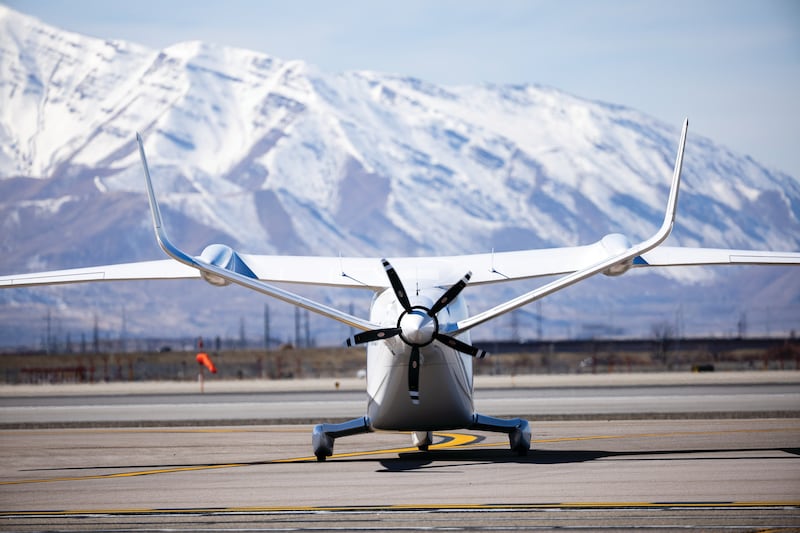
Private companies and government officials have spent recent years laying the foundation for a network of advanced air mobility projects, intending to transport both goods and people. Proposed plans include increased use of drones in the commercial sector, air taxis, movement of medical supplies and the development of new aircraft known as electric vertical take-off and landing (eVTOL). Collectively, this sector is known as advanced air mobility.
In March 2026, Utah was chosen by the federal government as one of eight states testing these new aircraft and funding early-stage projects, drawing a mix of large and small companies together. Already, the development of this sector has brought opportunities for national and local companies. Utah’s Vector Defense has teams based in Ukraine and Israel developing unmanned systems, working with militaries to develop drones for warfare. Lindon-based Fortem Technologies won a $25 million investment from Lockheed Martin to develop systems that counter drones.
The proposals carry weight in a state like Utah with a mix of urban and rural applications. With Utah’s help, ordering packages, transporting hospital patients and going about daily life could look different in the decades to come.
Drummond, who’s based in Arizona, thinks Utah is a natural fit.
“Utah is not being utilized properly,” Drummond says of aviation systems in the state. “The landscape of Utah actually lends to using these types of technologies because everything, like Arizona, is very spread out. So Utah was really in the hot seat for us looking into this.”
Drummond spent her career in aviation and created a company that rents out private jets. She noticed a pattern around the same time her interest in drones was growing: Charter clients would fly from Nevada into Utah, and then take their private jet around the Beehive State before returning to Nevada. There was a gap in Utah’s charter flights market, she notes, and she saw an opportunity to expand.
But advanced air mobility companies are eyeing an even bigger opportunity. Already, advancements within this burgeoning field are creating new avenues for military applications. The federal government, meanwhile, views the industry as crucial to edging out Chinese manufacturing and military encroachment.
The green light
After the Trump administration signed an executive order last June titled “Unleashing American Drone Dominance,” the regulatory environment surrounding low-altitude air transportation shifted. The policy required the federal government to advance testing of unmanned aircraft flights and address policy gaps, increase the use of AI in drone development and begin testing eVTOLs.
For several years, Aaron Starks, CEO and president of 47G, had been looking into the aerospace and defense sector, and more specifically, eVTOLs and advanced air mobility. After he left his role as chief revenue officer at World Trade Center Utah five years ago, he joined a company looking to raise $20 million for advanced air mobility. They raised the money, and Starks says, “I fell in love with the idea of digitizing airspace above critical infrastructure, delivering people, parcels and packages via drone technology and air taxi.”
He began talking to insiders from aviation and military-adjacent fields, government officials and investors about these projects to try to build up interest.
“I then founded 47G and immediately went to work on putting together a vision for the state to follow on air mobility,” Starks says. He gathered a roundtable of partners, including Utah’s Department of Transportation (UDOT).
UDOT had also been looking into this area for years, considering what kinds of legal frameworks need to be put in place, both for safety and to prevent regulation from hindering development.
“The possibility of all these things happening — as a state, we’ve been looking at it since the early 2010s,” says Matthew Maass, director of the UDOT Division of Aeronautics. “We’ve realized that this was going to be coming and we needed to prepare for it.”
47G’s roundtable became Project ALTA, which developed a project called uFLY, led by UDOT to coordinate with Oklahoma, Oregon, Idaho and Arizona.
“I like to think of 47G as a bit of the architect on this,” Starks says. “We don’t build infrastructure, obviously; that’s the state’s responsibility. But we convene all of the partners and especially the industry to advance these efforts.”
Then came the eIPP, or the eVTOL Integration Pilot Program, a round of funding dedicated to state-led projects announced by the Federal Aviation Administration (FAA) in March. UDOT was selected as one of eight partners across the country to test and develop this sector of advanced air mobility. Several private companies, both inside and outside Utah, will also test this field under UDOT’s oversight.
“For us, this is really about moving things out of research and development and moving this into commercialization,” says Patrick Buckles of BETA Technologies. “We’ve been able to demonstrate the aircraft now for multiple years, flying all over the U.S. through the state of Utah, [including] dedicated demos we did with UPS.”

The benefits are robust, as Starks points out that one of BETA Technologies’ key materials is developed in Utah, with federal funding bringing more industry-adjacent businesses into the sector.
Maas, meanwhile, points out that this project is largely about creating safety procedures and exploring the existing underlying infrastructure. While the federal government has jurisdiction over airspace, Utah will look into establishing norms for cities, construction and planning. For example, outlining the zoning that would allow constructing a “vertiport,” or vertical takeoff and landing site. Maas also notes airports have been planning for possible impacts of electric vehicles for years, and $2 million was recently appropriated for eVTOL charging stations at Utah airports.
Military applications and cutting red tape
For Red Cat Holdings’ Brendan Stewart, the company’s senior vice president of regulatory affairs, the federal eVTOL pilot program allows his company to help clean up regulations that drone companies view as restrictive. At the same time, he says, the program can increase drone manufacturing in the U.S.
“I started with Red Cat back in 2021, with the goal to advance American drone manufacturing into the 21st century and create a manufacturing base as a bulwark against China,” Stewart says.
For the companies, it’s also a way to explore how this industry can create offshoots for them, as the peripheral technology and new developments may lead to new revenue.
Lydon Sleeper, the head of U.S. strategic policy at Joby Aviation, says, “Essentially, what the eIPP will do is it’ll allow us to partner with states and the federal government, the FAA and the Department of Transportation to pull forward some of our commercial operations plans.” He views the project as a chance to have the federal and state governments provide “a little extra regulatory support” so the private sector can help cut red tape and explore policy.
He notes that Joby is likely to partner with the Department of Defense on future projects, too. As the sector grows, the militarization aspects could compound. In an example Starks gives, some of the byproducts and materials used in making eVTOLs can have additional use to the military and help deepen Utah’s role in that sector.

“One of those technology areas that had been announced was advanced materials,” says Starks, explaining that carbon fiber composite is often used in the construction of aircraft. “We’re now putting them on missile silos and cones. … We are maybe the carbon fiber composite Mecca of America.”
For industry leaders, that’s part of the appeal. The effort to build a new aviation ecosystem is creating opportunities that reach far beyond passenger flights, from manufacturing and materials science to defense and infrastructure.eVTOLs still have regulatory hurdles, infrastructure challenges and public skepticism to overcome before Utahns can hail an air taxi as easily as calling a rideshare. But for people like Drummond and Starks, as well as companies, policymakers and aviation enthusiasts building the industry, the future of flight feels closer than ever.