

The Lanham Act is a federal law that generally prohibits companies from making false and misleading statements in their advertising and marketing. This has long been the law. A recent decision out of the United States Court of Appeals for the Tenth Circuit, however, has expanded the scope of what might give rise to liability. In KetoNatural Pet Foods, Inc. v. Hill’s Pet Nutrition, Inc., the Tenth Circuit determined that a company may be held liable for false or misleading statements that appear on a third-party’s website reached via hyperlink from the company’s website. This urges caution in not only evaluating what statements a company is making itself, but also those statements that it refers to in a promotional way.
Hill’s Pet Nutrition is one of America’s largest and oldest pet food companies. It sells traditional pet food that contains grain as a primary ingredient. KetoNatural is a boutique manufacturer that produces and sells grain-free pet food (also called “BEG” pet food). BEG pet food has gained popularity in the United States, which has impacted Hill’s business.
According to KetoNatural’s Complaint under the Lanham Act, Hill’s attempted to bolster its business by working with veterinarians and nonprofit organizations to disparage BEG pet food and representing that BEG diets were linked to a higher risk of canine heart disease. It did this by linking to blog posts and articles discussing the same on third-party websites. For example, Hill’s’ webpage stated that “trends” such as “grain-free, raw, vegan, farm-to-table, plant-based, or homemade” dog foods can “pose health risks for dogs” and hyperlinked “health risks for dogs” to a veterinarian’s blog bolstering the alleged link.
KetoNatural sued Hill’s for false advertising under the Lanham Act. To state a claim for false advertising, the plaintiff must allege, among other things, that the defendant made false or misleading representations of fact in commercial advertising or promotion. The United States District Court for the District of Kansas initially dismissed the Complaint and KetoNatural appealed.
On appeal, the Tenth Circuit relied on traditional considerations of what might constitute commercial speech under the Lanham Act: (1) Is it an advertisement? (2) Does it reference a specific product? (3) Was the statement made with economic motivation?
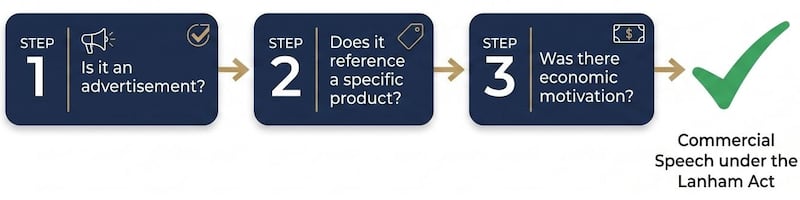
Applying this framework to Hill’s website, the Tenth Circuit concluded that KetoNatural plausibly stated a claim for false advertising and allowed the matter to proceed in litigation. The Court explained that while the representations on Hill’s website did not constitute a “classic advertising campaign,” they functionally served to promote Hill’s traditional grain-based products. By disparaging BEG-diets, Hill’s tacitly promoted its own pet food. And these statements were made with the economic motivation to regain Hill’s declining market share.
The Court reached the same result for the statements linked from Hill’s website. Hill’s argued that any disparaging statements on the linked websites did not constitute commercial speech because they made no mention of Hill’s products. The Court disagreed, ruling that the hyperlink’s location (embedded in Hill’s website) and the fact that the linked pages disparage BEG dog foods can plausibly be understood to promote Hill’s products.
But this doesn’t mean that Hill’s can be liable for any statement that is out there. Rather, the Tenth Circuit concluded that Hill’s could not be held liable for statements made by veterinarians or non-profit organizations. KetoNatural did not plead any facts demonstrating that these third parties were compensated or otherwise received a quid pro quo from Hill’s for disparaging BEG pet food. According to the Court, these third-party statements were too attenuated from Hill’s to be understood as commercial speech. The representations did not mention Hill’s, let alone promote its products. Nor were there any allegations suggesting that the veterinarians or non-profit organizations were economically motived in making these representations.
Ultimately, the Tenth Circuit’s decision had the effect of allowing litigation to move forward. We still don’t know how KetoNatural’s claims will fair as the matter continues. But, in the meantime, the impact of this decision goes far beyond pet food.
While content on a third-party website may, standing alone, constitute protected expression, directing consumers (through embedded hyperlinks) to that content as part of promotional message may be evaluated as commercial speech under the Lanham Act. The KetoNatural matter suggests that companies should review their hyperlinks with the same discipline as claims appearing directly on their webpages. And companies should ensure that scientific studies or articles accurately reflect the conclusions of the underlying data.

If you have questions about these principles or need guidance, Parsons Behle & Latimer’s intellectual property attorneys have deep experience in helping clients navigate these issues. Learn more at www.parsonsbehle.com/capablities.