
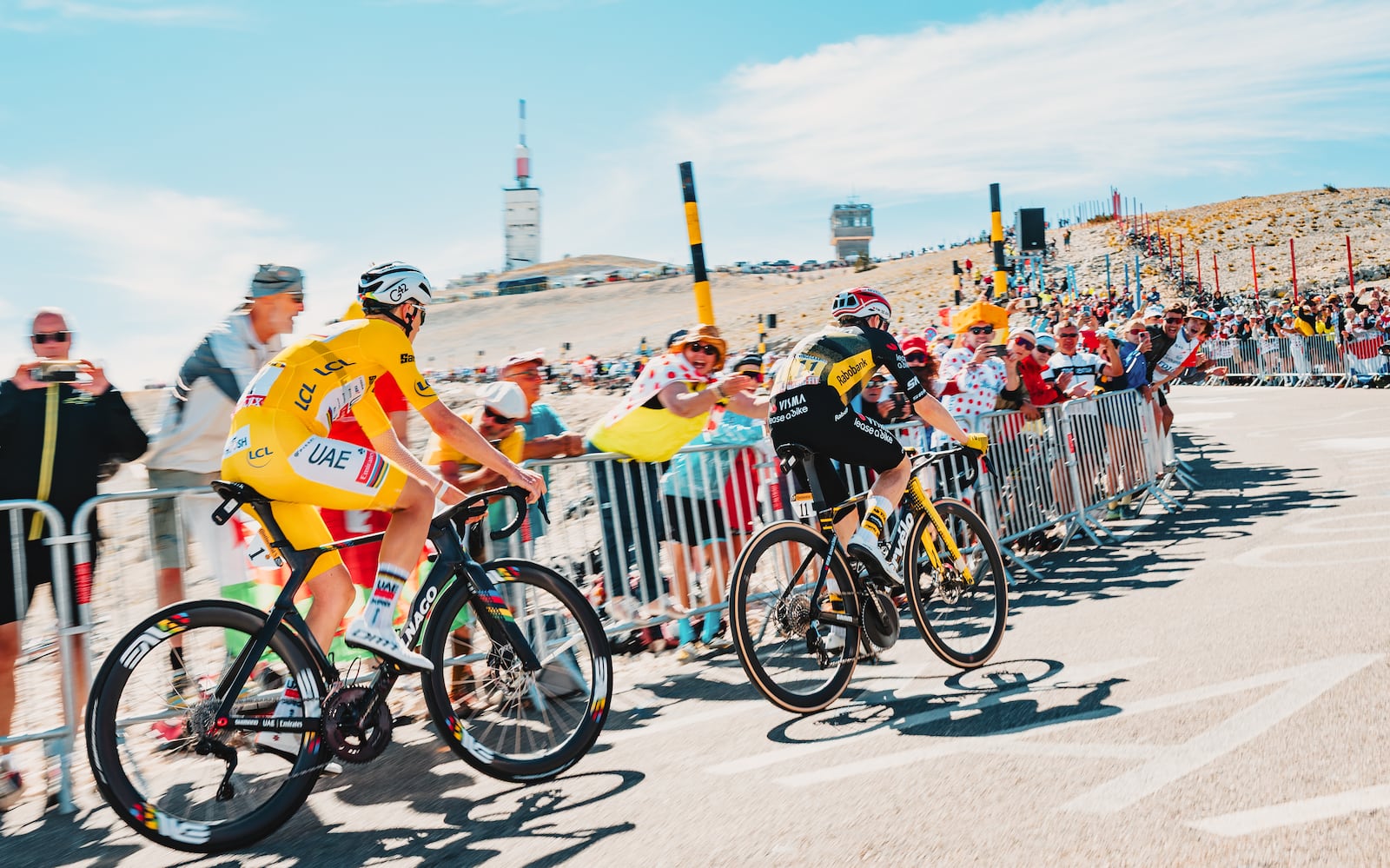
Utah is competing in the Tour de France this year, and not in the way you expect.
This Saturday, Tadej Pogačar, widely considered one of the greatest cyclists of all time, is chasing a third consecutive Tour victory. Beneath him are wheels handcrafted and engineered right here in Utah.
In a sport where a split second is the difference between winning and losing, Utah-made wheels have already carried Pogačar across the finish line for two of his four Tour de France titles.
While the majority of the outdoor cycling industry has spent years outsourcing production to Asia for lower labor costs, ENVE Composites has kept its engineering, manufacturing and assembly under one roof in Utah. Headquartered in Ogden, ENVE manufactures high-performance carbon fiber wheelsets, components and frames at the base of the Wasatch Range.
So why did this cycling legend come to Utah for his wheels?
It started with a cold email.
Several years ago, UAE Team Emirates was looking to upgrade their equipment and was putting several high-performance brand wheels through rigorous testing. Unbeknownst to ENVE, their wheels were thrown into this competition and came out on top, eventually leading to a partnership in 2023.
“They actually emailed us and reached out on their own,” says Neil Shirley, VP of marketing for ENVE. “They had taken competitor products to the wind tunnel, rolling-resistance testing and conducted objective ride testing. To come out on top and have them approach us, it was pretty surreal.”
The made-in-Utah advantage
While competing brands outsource to Asia to maximize margins, ENVE operates on a performance-first model.
“We develop the best product we possibly can,” Shirley says. “We aren’t trying to hit a price target. Whatever that price needs to be to keep us in business while building to our standards, that’s where we set it.”
In an industry where offshore manufacturing has been the standard cost-saving strategy, ENVE’s dedication to local production gives them a distinct competitive edge. That willingness to accept higher domestic manufacturing costs provides a massive strategic benefit: near-instant iteration speed.
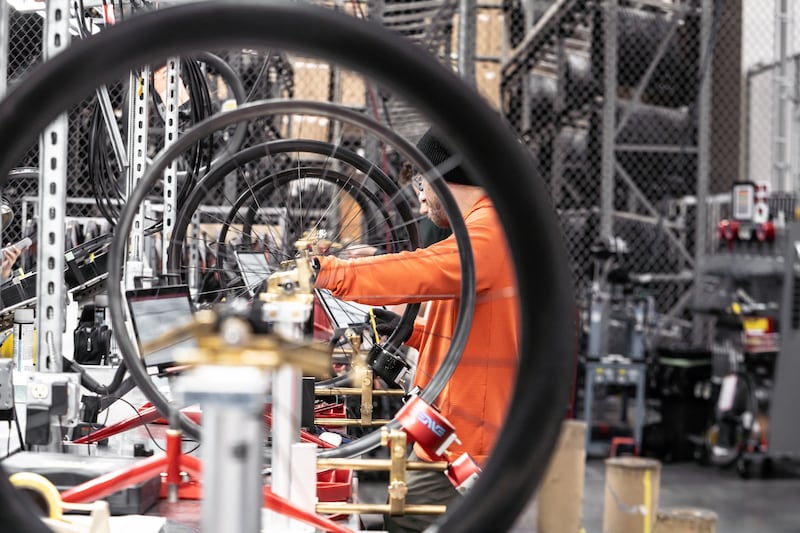
Because engineering, carbon layup, mold production and testing labs all sit inside a single facility, ENVE can capture real-time feedback from professional athletes and transform it into a physical prototype within hours.
“We could iterate on a wheel design, a handlebar or some other product almost overnight, whereas if you were reliant on vendors to be doing that, that’s potentially months,” Shirley says.
The Utah formula: Climate, talent and passion
Long before reshoring and onshoring came into the spotlight, ENVE was committed to proving the viability of domestic advanced manufacturing from its Utah headquarters. As more U.S. brands look to bring manufacturing back stateside, ENVE’s two-decade track record shows how domestic manufacturing can thrive and why Utah is uniquely positioned to lead the nation’s advanced manufacturing future.
ENVE leadership has pointed to three uniquely Utahn factors that have contributed to ENVE’s success: climate, talent pool and passion.
“Composite material suppliers have set up in northern Utah partially because it’s so dry here,” says Kevin Nelson, ENVE’s chief design engineer. “Having that sort of moisture consistency is important for composites. Because of that, there are a few factories that have sprung up here.”
Beyond the climate, northern Utah has a dense cluster of aerospace and defense composite manufacturing, anchored by Hill Air Force Base and regional defense contractors. This ecosystem provides ENVE with a specialized labor pool already knowledgeable in high-stakes carbon composite manufacturing, where even the smallest of details make all the difference.
“Keeping the [tools] clean is important,” Nelson says. “All those little bits of cured epoxy, if one of those pieces, even if a tiny piece, gets stuck to a tool and doesn’t get cleaned off before it gets laid up again, that will create a scrap wheel the next time. The cleanliness and attention to detail are really critical at every step.”
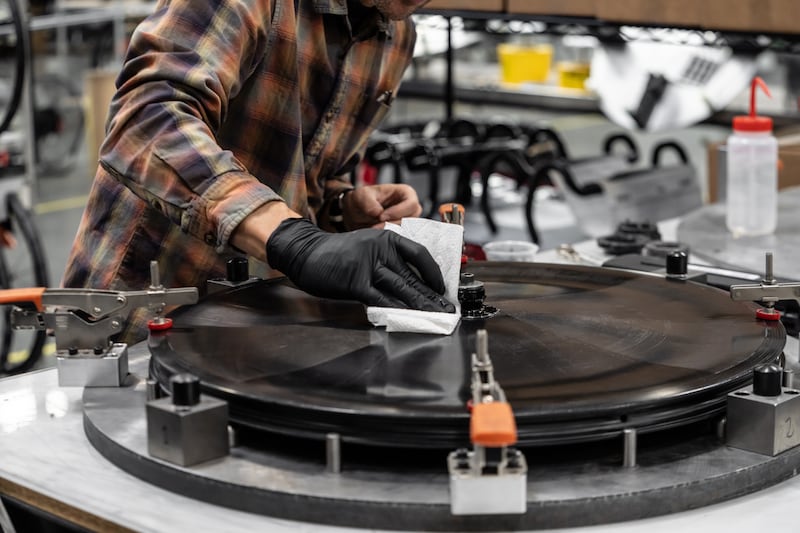
Situated in Utah, a hotspot for mountain and road cycling, the high level of expertise is often paired with genuine passion for cycling. Those who work at ENVE have the opportunity to apply their advanced knowledge to products they ride and love.
Several ENVE employees have been in the industry for a long time, but didn’t work in places that made bikes. Their operational precision and passion for the sport are exactly what makes ENVE competitive on the global race stage.
Nelson, a passionate cyclist himself, says, “Being able to find a place where you can make [bikes] and get that little extra 5 to 10% of your design intent into the final product, it matters. The racers are looking for marginal gains to improve, and we’re doing the same thing as an engineering group. And that means you have to know how it’s made fundamentally.”
Shirley adds, “That goes straight into Tadej and the UAE team because that 5 to 10% difference is the difference between winning and losing.”
Craftsmanship at a Tour de France level
Building high-end carbon components is both advanced engineering and painstaking craftsmanship. Each bike part is made up of carbon sheets that are precisely placed and pieced together, at a level that no machine can replicate — making every wheel high stakes, both financially and reputationally.
“We have to be functioning at the highest level all the time because if we lose a wheel, it’s hours of labor that gets thrown away,” Nelson says. “The next race will be a little bit faster, harder, more competitive. You’ve got to constantly be pushing forward. That’s what we do, and that’s what they expect of us.”
Being held to a professional standard demands operational discipline across every step of production. When producing at such a costly and labor-intensive level, quality control failure directly impacts profitability and cyclists, whether they are a professional athlete or a hobbyist.
“The athletes are always improving, and they expect that out of us,” Shirley says. “We love and enjoy it, but we feel very responsible. We have a huge responsibility to create the best but also the safest products for the consumer and for everyone else.”

To maintain those standards, ENVE relies heavily on high-touch communication and a shared culture of cycling passion.
“Every one of those people in the building is playing a role in the quality of each product,” Nelson says. “We have a lot of communication every day between groups to function at the highest level all the time.”
It takes a world-class team to build equipment for world-class athletes. And for ENVE, that’s a point of pride Shirley believes all of Utah can share.
“For Utahns to know that there’s this small carbon company making bikes and bike wheels in Ogden that are being used at absolutely the highest level of the sport and winning — I think that would make me proud as a Utahn.”
