

This story appears in the April 2026 issue of Utah Business. Subscribe.
Each of Utah’s 29 counties offers unique advantages for businesses and talent alike. Let’s visit Rich County.
Utah’s world-renowned landscape boasts mountains covered in “The Greatest Snow on Earth,” five national parks featuring gigantic red rock cliffs and naturally occurring arches, and the largest inland body of salt water in the Western Hemisphere. Despite the landlocked state’s arid desert climate, Utah even manages to host over 1,000 fishable lakes and plenty of well-known spots for swimming and boating.
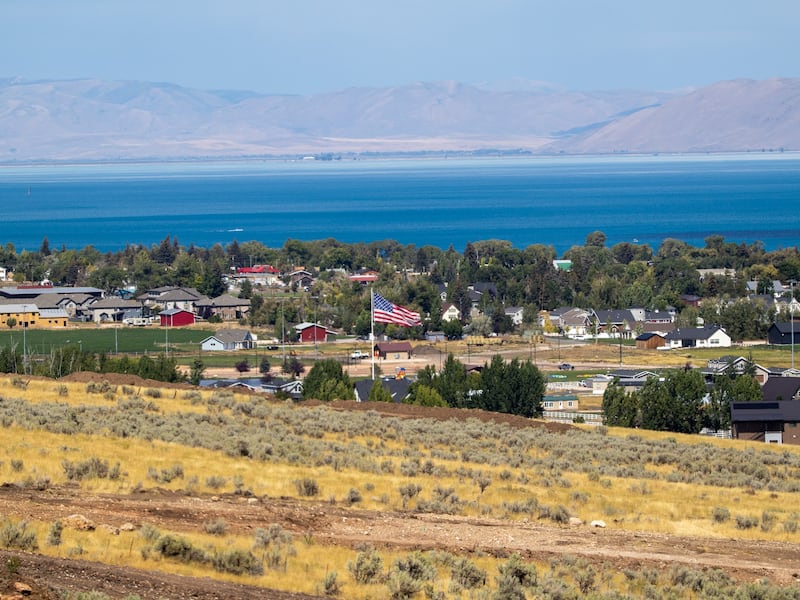
Rich County won the geographical lottery and contains half of Bear Lake, one of Utah’s most popular spots for water recreation. The lake’s tourism draw earned it a $62 million marina expansion in May.
According to Shawn Milne, director of community and economic development and intergovernmental affairs for the Bear River Association of Governments, the state’s significant investment in the marina is an acknowledgement of the area’s growth and a sign that now is the time to plan and prepare for an economic boom.
Step one: balancing long-term, year-round business growth with short-term, warm-weather tourism.
“Both Bear Lake County, Idaho, and Rich County, Utah — each having about half the lake inside their jurisdiction — realize the asset that they have in their midst,” Milne says. “They realize that it’s the anchor for the outdoor recreation draw and tourism economy, and so they want to make sure that the tourism industry and the agricultural industry can [coexist].”
Taking on tourism
While agriculture remains the county’s dominant industry, claiming roughly 11% of economic output, tourism is a major part of the economy. During the offseason, Milne says the county currently has about 4,000 residents, a number already double that of the 2020 census, which counted 2,510. When summer comes, the area will host a staggering 35,000-40,000 people each holiday weekend.
The sudden growth each summer can be difficult for the area to handle. Milne says county leadership often looks to examples like Park City and Moab for solutions to manage the drastic influx.
“Bear Lake is coming to the realization that we can either, more expensively, retroactively, try to think about our growth after it’s already happened to us, or, as this [marina] project envisions, we can try to own it right at the top,” Milne explains.
Rich County began to see growth during the COVID-19 pandemic. As remote work grew and professionals dispersed from city centers, Garden City, the largest town in the county, saw over 80% of its homes become secondary residences. Milne says many of the homes are rented out as Airbnbs or VRBOs to tourists and remote workers.
While rental units support the area’s tourism economy, transient residents can make it difficult for permanent residents to build community. To help manage the quality of rentals available from the beginning and preserve community benefits, Garden City requires all short-term rentals to be licensed through the city.
Tami Leonhardt, the Rich County and Bear Lake County executive director of tourism for the Bear Lake Valley Convention & Visitors Bureau, says, “The city has kind of controlled the short-term rentals so that they don’t take over everything. … The visitor numbers — you cannot track them. … There are so many VRBOs and places to rent here.”
The licensing also helps the county collect and track transient room taxes (TRT), an essential income for rural counties handling large swaths of tourism. In 2021, Rich County totaled a little less than $860,000 in TRT for the entire year. There were some winter months in the last five years that only garnered a couple of thousand dollars. In 2025, however, the county totaled $1,324,323.
Getting back to your roots
As the county welcomes more tourists and TRT funds, locals worry there may need to be trade-offs. Nikki Weston, chair of the Rich County Economic Development Board, says her team is committed to making growth work for everyone.
“We have two separate business models here in the county. We’ve got tourism, and we’ve got agriculture,” she explains. “For the past four or five years, we have been doing small business grants, trying to build business here in the county. … We have lots of business here in the summer and not so many in the winter. This year, our goal is to try to increase full-time, year-round employment [with the grants].”
“Before, we didn’t have a big grocery store. We didn’t have a big hardware store. We didn’t have a bank here in town. … Now there are restaurants, … souvenirs … and new roads.”
— Tami Leonhardt
Recently, the board used one of its small business grants to help a local horse trainer build a barn that allows him to work through the winter. “He hired a local girl who wants to be a horse trainer, and she works with him,” Weston says. “Eventually, it will be [a full-time position the grants helped create]. Right now, she’s in school and gets to come home and work in the winter.”
By weighting the small business grants toward full-time residents, employers and business owners, Weston says the board is seeing heritage enterprises diversify, adding year-round commerce options such as creating recreational trails on unused farmland.
“Our offseason is growing each year, and you’ll see that in the numbers,” Leonhardt says, referencing the county’s January TRT going from $24,000 in 2021 to $62,000 in 2025. “Before, we didn’t have a big grocery store. We didn’t have a big hardware store. We didn’t have a bank here in town. … Now there are restaurants, … souvenirs … and new roads.”
Randolph, Utah, the county seat, will even be gaining a new custom cabinetry shop. Weston’s board is looking into how its grants can support the company as it starts operations.

“A cabinet company is going to bring 15 full-time employees to the county. We’re going to set aside some money to help them with some infrastructure up there,” Weston says. “We’re just trying to help make his life a little easier as an incentive there. … If we help him get the infrastructure up there, it will expand.”
As the economy and population continue to develop, staying ahead of the curve with careful planning and purposeful allocation of resources will allow residents of Rich County to avoid growing pains and simply enjoy the stretch.