
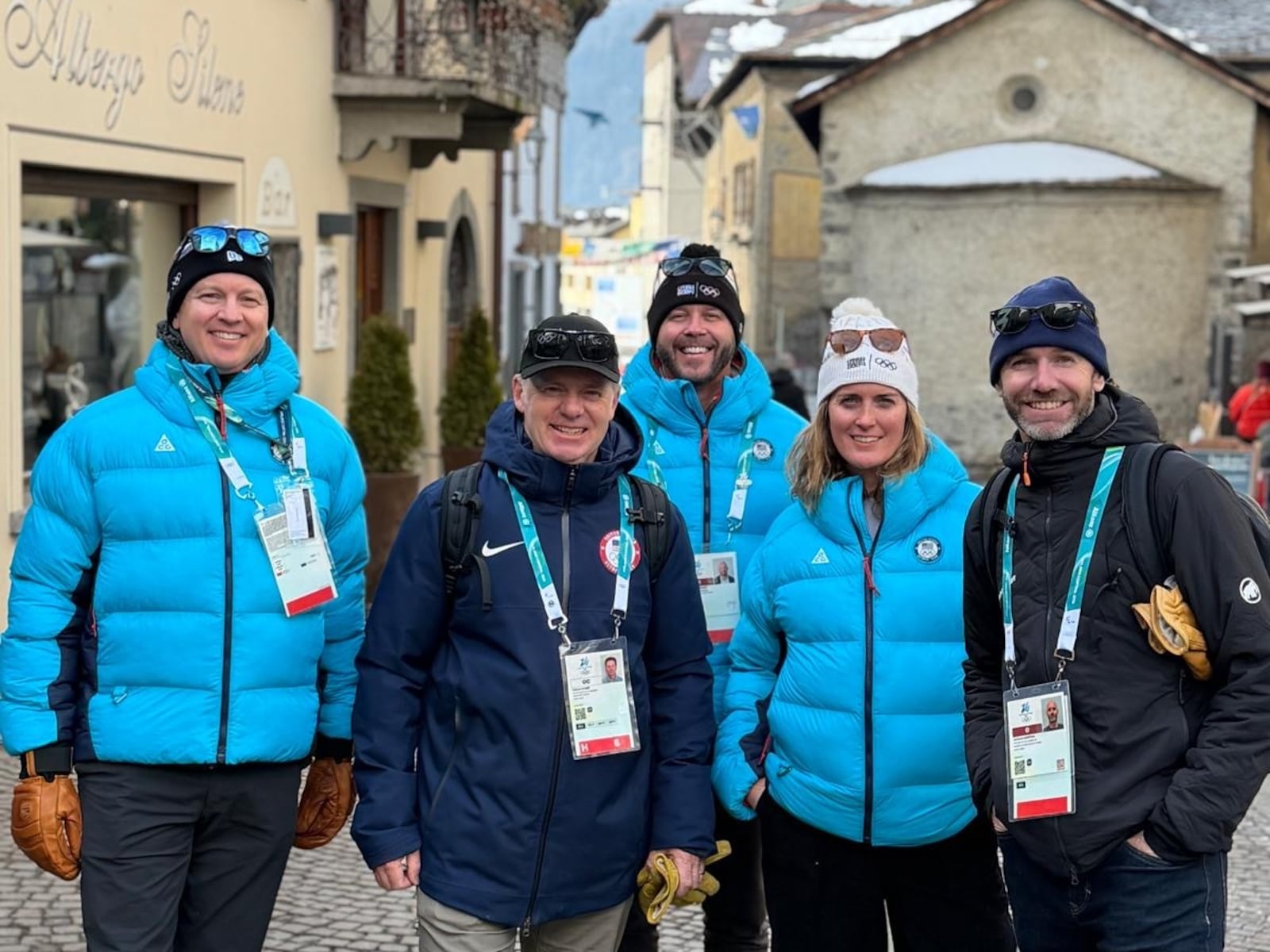
During the Milano Cortina 2026 Winter Olympics, Davy Ratchford, COO of Snowbasin Resort, spent six nonstop days in February moving between events, talking to dozens of people and asking as many questions as he could.
He and a group of other Utah ski tourism leaders met in Italy to be watchful observers of how the country pulled off a monumental event across many alpine cities and resorts. Leaders from the Utah Olympic Legacy Foundation, the 2002 Winter Olympics in Salt Lake City, the Utah 2034 Olympic and Paralympic Games, and Ski Utah played a role in assembling the group, which included executives from Deer Valley Resort, Park City Mountain Resort, Snowbasin Resort and others. This group approach fostered great dialogue as they moved between venues.
“Utah works really well together,” says Ratchford. “This group has a common vision and drive to show off how great the state is, and I think their leadership has been super helpful in pulling the trip and the experience and the logistics together. … They said, ‘Let’s get together, learn and then co-create what’s going to be an absolutely amazing experience in 2034.”
Olympic events spread across Milan, Cortina d’Ampezzo, Livigno and Fiemme with 116 medal events across 16 disciplines, using existing infrastructure for a sustainable, regional model. The Utah crew was eager to see as much as possible to begin mentally preparing for Utah 2034.
Ratchford made sure to attend the downhill skiing events, as that’s what Snowbasin will be hosting, while Todd Bennett, COO and president of Deer Valley Resort, prioritized watching moguls, Deer Valley’s event.
Accommodating the masses
In 2002, Snowbasin erected a 20,000-person stadium, which will need to be rebuilt before the 2034 Olympics begin. With hundreds of thousands of visitors expected to travel between Utah’s city centers and mountain resorts, leaders are remembering the logistics of the last Olympics and thinking heavily about Utah’s infrastructure and transportation. The good news is this isn’t Utah’s first rodeo.
Utah’s ski resorts don’t just want to accommodate visitors during the Olympics; they want to accommodate pass holders, too. In Italy, most of the resorts were shut down entirely while events were underway. Ratchford says business must go on as usual in Utah. Shutting any resort down for a few weeks would disincentivize potential season passholders from purchasing.
“When I was in Borneo for the men’s downhill [events], the mountain was closed,” Ratchford says. “Our model is to … be here, enjoy it, but also ski and use the mountain.”
Additionally, the group of resort leaders discussed how the Olympics is a great opportunity for visitors to experience multiple Utah resorts, including Solitude and Snowbird, which won’t be hosting Olympic events. Because resorts are relatively close to each other, Utah offers an exciting ski experience that will only be amplified by the Olympics.
Infrastructure and transportation
Transportation was the topic of many conversations in Italy. Because the 2026 Winter Games were spread across hours of Italian terrain, moving spectators between venues required a tightly coordinated network of trains, buses and event shuttles.
“It’s a little hard to compare Utah directly because Italy was so spread out,” Ratchford says. “That’s one of Utah’s advantages — everything is so close together.”
Still, there were details worth studying. When visitors arrived at the Milan airport, Olympic staff directed them to welcome stations where they could pick up credentials and get oriented to the transportation system.
“You could scan a QR code and it would get you train access or bus access pretty easily,” Ratchford says. “Right from the airport, they helped you understand how to navigate everything.”
Utah Transit Authority representatives were also part of the delegation, observing how Italy managed mobility during the Games.
While Bennett was equally interested in seeing how Italy’s Olympic team moved people between venues, he was also interested in seeing how spectators flowed in and out of the venues themselves. The Deer Valley Resort team knows a thing or two about hosting — they have welcomed ski pros and enthusiasts to their venue for a few dozen World Cups — but they were looking for new ideas to improve their customer experience.
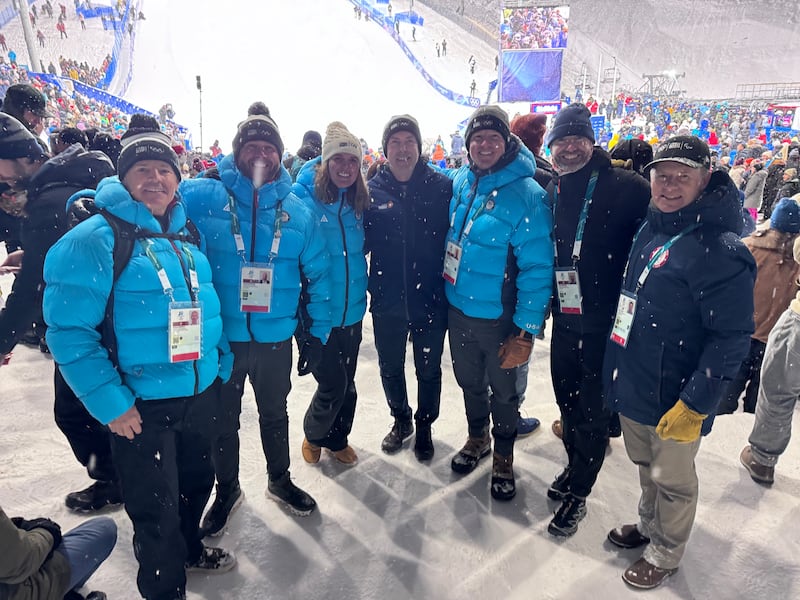
Designing an Olympic gathering space
The city of Lavigno, Italy, mimicked Park City in a number of ways. Both offer world-class mountain tourism, are major ski destinations and offer a laid-back yet luxurious mountain lifestyle.
“I think the energy of Lavigno was very comparable to what we could do in Park City,” Bennett says. “Park City is going to have multiple venues, between the ski jumps, the bobsled track, skeleton and luge. Park City Mountain is hosting its freestyle events, and we are doing moguls and aerials. There’s just a lot of density and energy.”
He says you could feel the “Olympic spirit” vibrantly while walking through Lavigno, making it feel like its own condensed international world. It’s where people were grabbing a bite to eat, watching the events live on large TVs and projectors.
“They had activations in what would be the equivalent of their large town or city park,” Bennett says. “It was kind of a pop-up village. … The energy felt really great there. I think that’s something I’d love for Park City to emulate.”
He says feeling that energy was his big “aha!” moment. In 2034, Bennett’s vision is to make Deer Valley a hub for celebration and connection. It can also serve as a home base to return to between events.
Utah ski resorts on the big screen
Leaving Italy, it became even more real just how many eyes will be on Utah when it hosts the Winter Games. Ratchford says he started thinking about how many people would see Snowbasin from phones and televisions.
Utah leaders know they can handle the logistics of hosting another Olympics, Bennett says, because there is proof of concept, so the real focus is on further elevating the experience to showcase the Beehive State. It starts with each organization and company executing their specific roles flawlessly.
“The objective for the [Snowbasin] team here is to put on the greatest event we possibly could have,” Ratchford says. “You know, for these athletes to deliver an experience that allows them to promote the very best. For that, me and my team’s responsibility is to get the actual ground right … and to give them the best opportunity to have the success they need.”
