
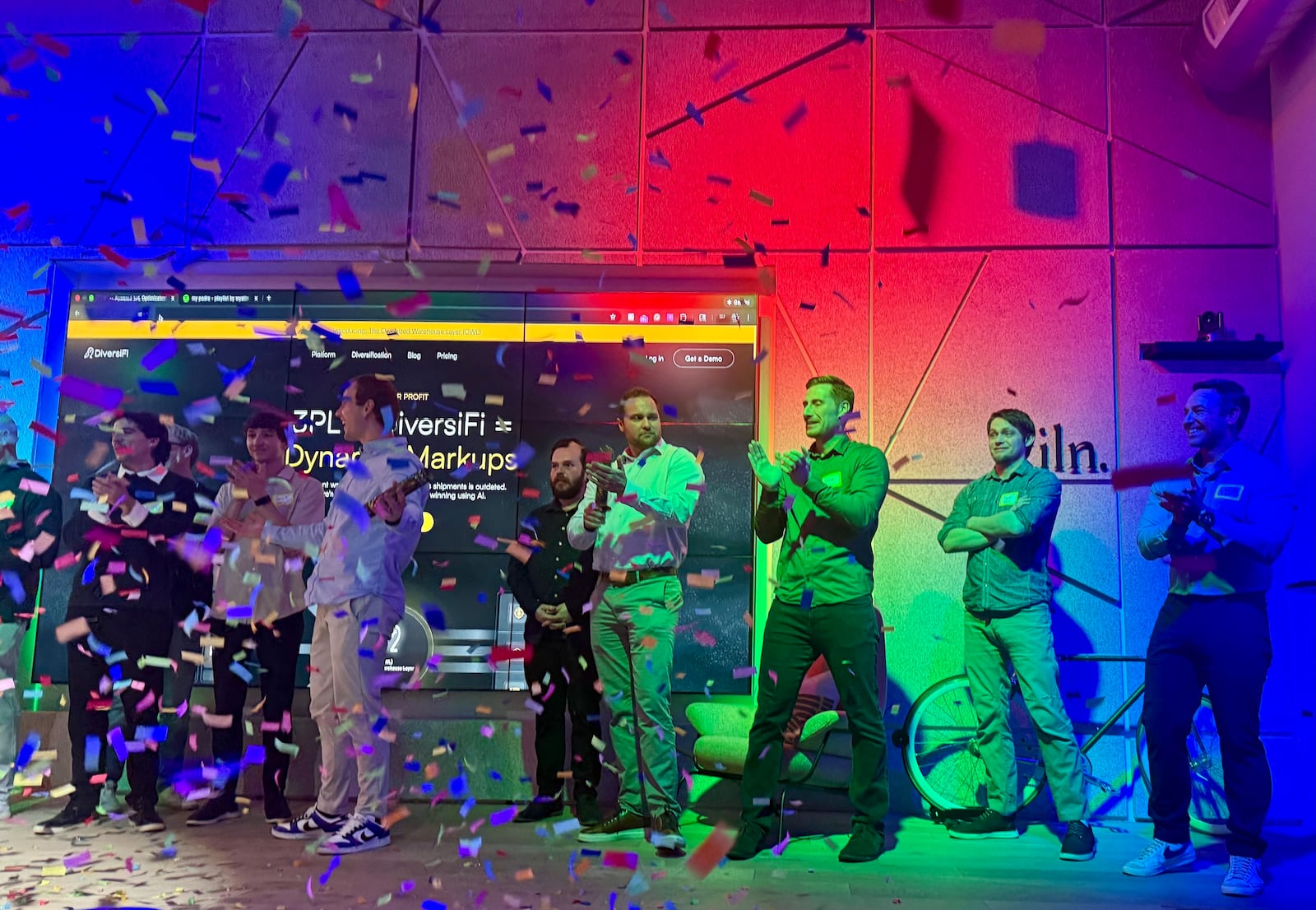
On Friday, Salt Lake City AI startup DiversiFi announced an $8 million funding round. The company, which uses artificial intelligence to help 3PLs optimize operations and protect margins, has seen explosive growth — expanding its team by more than 600 percent from 2025 to 2026. Backed entirely by Utah investors Sorenson Capital, Kickstart and Peterson Ventures, DiversiFi has quickly outgrown five different downtown Salt Lake City offices in the past year alone as it builds technology for an industry projected to reach $2 trillion by 2030.
CEO Caleb Nelson, who founded the company after witnessing firsthand the challenges facing logistics providers, chatted with Utah Business about the funding round and DiversiFi’s plans to reshape how 3PLs operate.
What specific proof points or milestones convinced local capital that DiversiFi was ready for $8 million now, and how do you plan to deploy that capital over the next 12-18 months?
VCs have backed us because we have passed our “idea stage” and are now in full execution, providing value and solving pain for our customers. Some of the green flags for our VC partners were our traction, rapid revenue growth and our ability to stay laser-focused on executing quickly. The biggest proof was hearing from our actual early adopters and having them evangelize DiversiFi. Over the next 18 months, the focus will be on scaling our AI models and expanding our go-to-market team to help as many shippers across the country as possible. Our potential customers are stuck between a rock and a hard place, and nobody wants AI for AI’s sake. We’ve found a great way to use AI to improve their revenue while making it simple to use.
The 3PL industry is projected to reach roughly $2 trillion by 2030 and is known for tight margins and complex contracts. Where in that value chain are you focusing first, and what parts of the P&L are you moving the needle on most clearly today?
DiversiFi is focusing first on the operational finance layer within the 3PL — where shipments, carrier costs and customer contracts collide. That’s where margin leakage happens and where teams struggle to understand profitability in near real time. In a nutshell, we help 3PLs protect margins and scale without adding headcount. We created a way for 3PLs to leverage our AI to unlock more revenue in their businesses.
Many logistics operators already use WMS, TMS and ERP systems. What are you replacing or sitting on top of, and how do you position DiversiFi to skeptical operators who feel like they’ve “heard the visibility pitch” before?
The main issue is that 3PLs are swimming in data. They don’t need more visibility. They need direct execution in the areas that drive the most revenue. This includes sales, billing and how they process shipments. What’s amazing about building software with AI today is that you can connect multiple disparate systems together. We are not a WMS, TMS or ERP system that is a
“rip and replace” to 3PL’s current system, we are a connected layer that makes their systems smarter. We work on top of the systems they already have, enhancing — not replacing — their tech stack so they can build profitable businesses and deliver better results for their customers.
You’ve said DiversiFi was founded out of firsthand experience with “pain and imbalance” in logistics. What were the specific problems or unfair dynamics you saw 3PLs facing, and how does your product attempt to rebalance power between brands and their logistics partners?
Having spent 20+ years in transportation, I believe that 3PLs have one of the most complex jobs in logistics. 3PLs are expected to protect margins in an industry that gives them almost no visibility into where money is actually being made or lost. The industry is intentionally complex. With 150+ fees that the carrier can assess at any time, it’s difficult for them to get accurate data. This causes issues that go unaddressed and lost revenue. Basically, they act as a bank, and if they don’t manage it right, they end up floating cash and losing money on every shipment that goes out their door. DiversiFi connects its systems and, for the first time ever, allows them to talk to each other, turning that order flow into profit.
DiversiFi has moved offices five times in downtown Salt Lake to keep up with hiring. What have you learned about building and scaling a deeply technical AI company in Utah, and how does being locally capitalized and staffed shape your culture and strategy?
Scaling in Utah has taught us two things: First, the talent here is real — you can build a deeply technical AI company without being in the Bay Area, as long as you can zone out distractions and hone in on where you can deliver the most value to your customers.
Second, culture has to scale faster than headcount. When you grow quickly, clarity beats charisma. Focusing and simplifying while working hand in hand with early customers is needed completely.
Being locally capitalized and staffed shapes our culture in a great way. We build for the long term, stay close to customers and operate with discipline. It’s a very Utah mindset — humble, high-output and practical. And strategically, it keeps us focused on building a durable business with real product value, not just chasing hype. There is a lot of hype within AI, and customers are starting to get a good nose for it. Using AI in very specific use cases to provide real value is 100 percent there, and that’s what the market rewards.
Looking ahead, what does success look like in five years?
We’re working in the 3PL space to begin training our AI models so we can deliver those specific AI use cases to the masses. Our long-term goal is to be AI for shipping for all businesses.
Think of anything that was delivered to your doorstep lately. More than likely, it was delivered in a brown truck (UPS) or a purple and white truck (FedEx). For an industry as massive as parcel delivery, why is it ruled by only two carriers? We believe providerslike Amazon, DoorDash, Uber, Ontrac, etc. will be a major force in helping shippers have more choices for faster, lower-cost delivery, rather than a duopoly. What’s missing is a smart connector at the time of shipment that uses AI to route shipments to the right carrier. This is what we’re building for and where we are going.
