
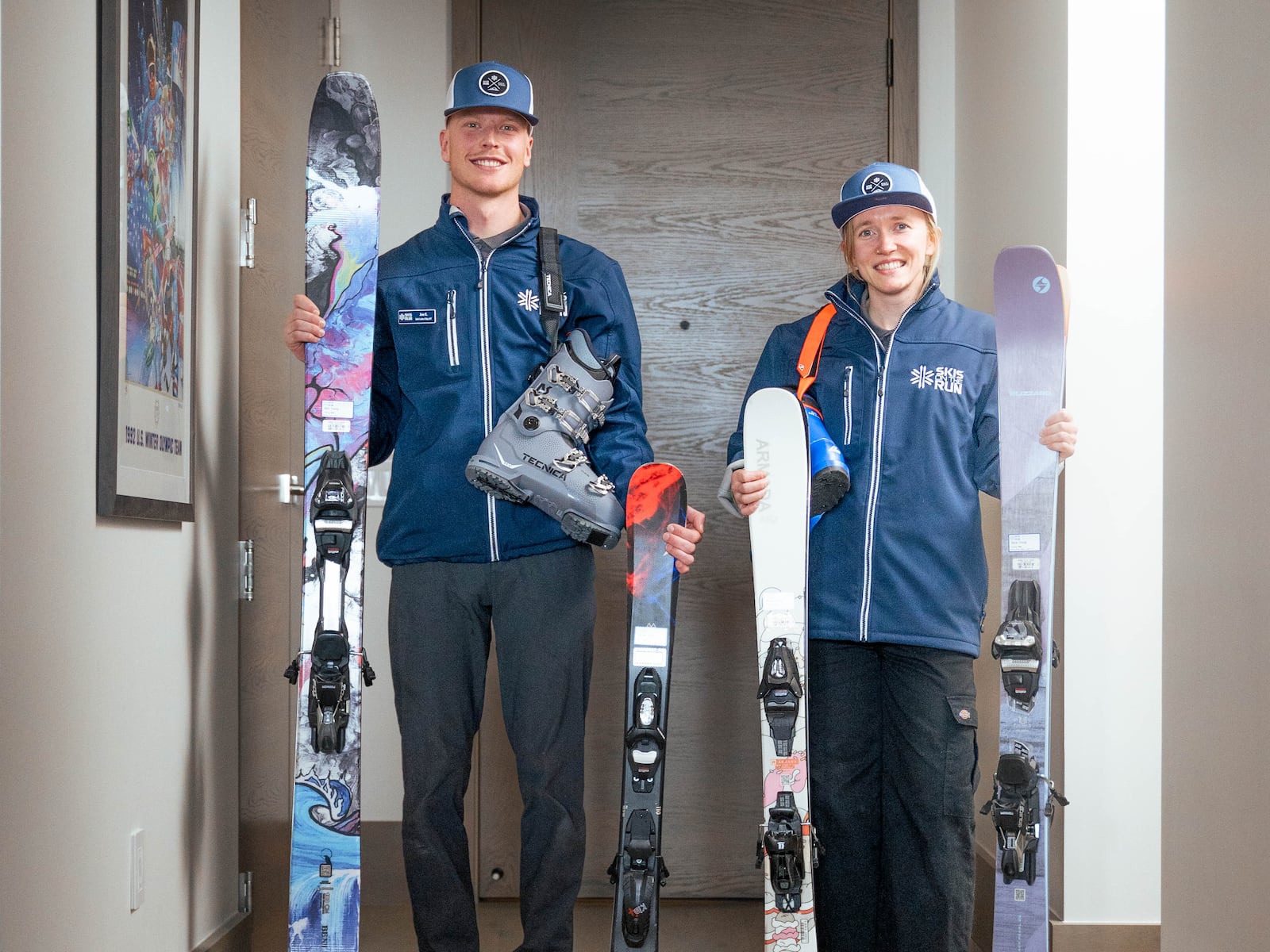
What do you get when you mix world-class skiing, business acumen and a penchant for the latest technology? The answer is Skis on the Run.
When Skis on the Run first opened in 2002, ski equipment rentals were still a new and unique concept in the United States. However, proximity to the slopes of Park City ski resorts and the company’s white-glove model of delivering the gear straight to customers’ rooms created a successful business.
“With the lodging so close to the resort, it’s literally ski-in and ski-out,” says Patrick Fannon, owner of Skis on the Run.
More runs, less waiting
With increasing resort prices, Fannon recognizes that every moment of a ski vacation is precious. Skiers don’t want to spend hours of their trip waiting in rental lines, and they don’t want ill-fitting options that underperform.
“At every point where there can be a bottleneck or excessive time spent, we’ve tried to create a process that either completely mitigates it or minimizes it,” Fannon says.
Skis on the Run prides itself on providing a “platinum service promise,” which involves going above and beyond from the beginning. The company can outfit anyone from head to toe with thermals, jackets, pants and all necessary ski equipment. They’ll also swap out gear that isn’t working or bring additional gear if needed.
That platinum promise includes the booking, fitting and pick-up process, but it also features top-of-the-line gear. Unlike other rental outfitters, Skis on the Run invests annually in the newest models of their equipment. In some cases, a guest will find the original packaging still in the ski boots and realize they’re the first to use it.

Customers can request the same brand and models as the previous year, but they do so knowing they’ll have the latest version. The quality of Skis on the Run’s gear is a strong differentiator and offering that Fannon says is reflected in the company’s pricing, but they make an effort to avoid being perceived as a luxury.
“It is a premium, but it’s not going to be twice as much as a traditional ski shop,” Fannon says. “It’s not like it’s going to break the bank when you see the total estimate at the end of the reservation.”
Fannon says it’s often families — especially moms — who see the value in their offerings.
“Our core customer is a woman, usually the mom, who takes care of the family,” Fannon says. “That’s not always the case, but 65 percent of the time, the person managing the trip logistics, specifically around the ski-related things, is the mom.”
A gnarly change of scenery
Fannon and his wife, Liz, bought the business in 2008. They and their young children were living in San Francisco, with Fannon working as a technology investment banker and Liz as a consultant at Deloitte. Having some roots in Utah — Liz is from the state, and the two were married in Deer Valley — they had an affinity for the mountains and outdoors. Fannon remembers realizing it was time for a change.
“We’d had our second child and I was working on a transaction in Tel Aviv, Israel,” he recalls. “On the flight home, I kind of was like, ‘This is not for me. This is not the path I want to be on.”
He and Liz were on the same page. While on a ski trip in Park City, they put out feelers, asking friends to let them know if they heard about any businesses that were for sale. Not long after, Fannon got a call from a friend who knew someone looking to sell their ski rental operation.
The timing was dicey. The financial crisis was just beginning, and the idea of taking on a new business might have deterred others. For the Fannons, it was meant to be. Within six months, they’d resigned from their jobs, sold their Palo Alto home, and bought the ski business.
Fannon says it was the best decision they ever made.

Carving out tech
Seventeen years later, Skis on the Run is more successful than ever. That accomplishment is largely thanks to Fannon’s investment in technology that keeps the business running smoothly.
“I was always a believer [in leveraging] technology to improve the guest experience, improve operations, and improve profitability,” says Fannon, who paid for his general manager to go back to school for programming. Today, Skis on the Run utilizes a fully custom software platform to take reservations, manage inventory and handle scheduling and billing.
All these capabilities also make the program a valuable business planning tool.
“It’s phenomenal for data mining, data gathering, understanding use patterns, utilization — all of those things,” Fannon explains. “So you can tighten up your inventory management in terms of what we have to spend each year to purchase new equipment.”
This specific insight is invaluable in an industry that operates for only a few months of the year. It allows Skis on the Run to have demand-based pricing; holiday weekends are busier, and pricing reflects that. In the ski industry, Fannon says, almost 40 to 50 percent of revenue is driven by four holiday periods, giving the business a small window to maximize its return.
Technology is also essential to ensuring the booking and rental process is effortless. Guests can book online, through email, or over the phone. The information gathered for a booking is also extremely detailed, making the fitting process seamless. A guest service agent gathers the height, weight, shoe size, age and ski ability level of every party member.
Since Skis on the Run offers a white glove boutique experience, details on lodging are also shared so the equipment is ready to meet them. All details are confirmed 48 hours before, and a ski technician is scheduled for the delivery, which is more than just a drop-off — a block of time is scheduled for a technician to personally fit each person’s gear. It also helps plan the team efficiently, keeping a technician in the same geographic area to fit in additional stops instead of losing too much time traveling between appointments.
“What validates our approach is that our highest customer base is repeat. The business model is working.”
— Patrick Fannon
Fannon says he tells these technicians that they are “more like a UPS driver than just a ski rental tech.”
At the end of a booking, guests simply share where they’ve left their gear and Skis on the Run will take care of the rest. They also ensure that all final billing is shared before the customer leaves, allowing any questions to be resolved quickly. Ideally, the guests leave without any loose ends.
“There’s a whole bunch of sauce on the back end that we implement operationally that makes it seem so elegant and efficient on the front end in front of the guest,” Fannon says.
Fall line into the future
The modern skier looks a lot different than the skiers of 2002 or 2008. Fannon says consumers are more discerning and have greater access to information. This evolution means businesses need to be smart if they want to stick around.
“If you’re going to be a premium-priced solution, the proof is in the pudding. Otherwise, they’re not going to use you again. There are too many other alternatives,” Fannon says.
He also believes that Salt Lake City and Park City are poised to welcome a new generation of skiers. Fannon claims the proximity of the airport to the slopes means that, on an ideal day, a skier can fly in at 9 a.m. and be on the slopes before noon. That’s good news for Skis on the Run, whose white glove service means the guest can also arrive to a full set of gear they know will fit and perform well.
Park City is also one of the few ski areas in North America that continues to see development and expand its capacity. Skis on the Run aims to be ready for the increase in skiers and demand.
“What validates our approach is that our highest customer base is repeat,” Fannon says. “The business model is working.”
