
Salt Lake County, the most populous county in Utah, is in the midst of a generational reshaping of how it invests and gathers at a greater scale than anything that the state has previously experienced.
“The sports and entertainment landscape in Utah is changing in a way we’ve never seen before in the history of the state,” stated Andy Moffitt, senior managing director with Newmark Mountain West. “The amount of investment, both public and private, reflects a shift in how people are living and spending their time and money. Attendance at sporting events and other types of entertainment is growing and people want a higher level of experience at these events. Utah will look very different in just a few years and will serve as an example for other states to follow.”
Underpinning this transformation are three billion-dollar-plus developments in Salt Lake County — The Three Pillars — supported by public and private funding: Sports, Entertainment, Culture, and Convention District (SECC); Power District; and The Point. Other significant developments and marquee events throughout the county reflect the broader transformation underway as Utah ramps up to host the 2034 Winter Olympic Games.
Demographic momentum
The demographic foundation buttresses the scale of growth and development.
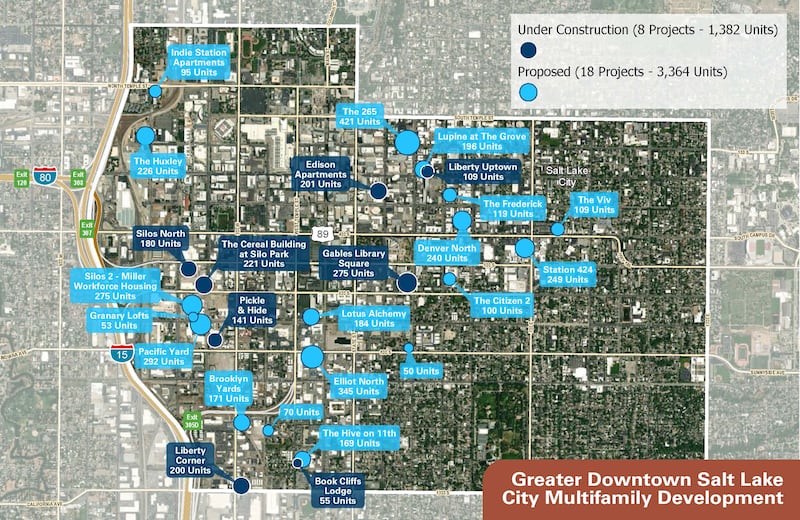
Utah is the youngest state in the country, with a median age of 32.4, and the Wasatch Front is projected to grow from 2.7 million in 2025 to 3.7 million by 2055. Greater Downtown Salt Lake City is densifying quickly, with more than 8,000 multifamily units added since 2020, nearly matching the combined output of the 2010s and 2020s.
Traditional single-floor retail is giving way to mixed-use, ground-floor activations as dense residential development reshapes the urban core. The push for greater density runs headlong into Utah’s deep-rooted car culture, forcing developers to navigate competing demands for parking and access that will only intensify as Downtown continues to densify.
Major investment areas
Western Governors University (WGU) has assembled 9.6 acres of prime Downtown real estate with plans for roughly one million square feet of office space, 5,000 on-site employees, and a stated commitment of $2.6 billion in local investment over the next 20 years.
For a stretch of south Downtown long fragmented by parking lots and surface roads, WGU’s project represents a fundamental reordering of land use and tenant demand, one that city officials expect to stitch the Granary District to the urban core and trigger a broader wave of private development in the process.
To the northwest, the Power District is emerging as one of the most consequential mixed-use opportunities in the region. Rocky Mountain Power’s new 10-story, 300,000-square-foot headquarters, which broke ground in October 2025, anchors a corridor that also includes a 15-year, $155-million Utah State Fairpark renovation and a potential MLB stadium.
Salt Lake City is widely considered a front-runner for MLB expansion as early as 2029, backed by robust public and private funding, a shovel-ready site and a broad coalition led by The Larry H. Miller Company. This development is poised to transform a historically underutilized stretch of the city into a year-round destination with sustained foot traffic, hospitality demand and retail potential.
At the south end of the valley, The Point is redefining what large-scale, mixed-use development looks like in Utah. Anticipated to be a catalyst for innovation and technological advancement, the 600-acre, state-owned site integrates transit, green space, trails, shopping and entertainment, creating a live-work-play community with few regional precedents.
With a University of Utah Health hospital campus now anchoring the project following a 46-acre land sale, a key piece of the puzzle is now accounted for, further driving the generational potential of the development.
The events calendar
The events calendar layered on top of the ongoing development is impressive. The 2027 Salt Lake Temple open house is expected to draw five million visitors over six months, translating to roughly 22,000 additional daily visitors downtown and a projected 20% boost in overall downtown visitation. The Downtown Alliance estimates $300 to $400 million in additional spending at downtown merchants and restaurants alone, before accounting for hotels, travel or transportation.
That same year, the NHL Winter Classic comes to Rice-Eccles Stadium, bringing national media exposure and destination-marketing reach that no traditional campaign could replicate.
And in 2034, Utah will host the Winter Olympics for the second time, leveraging 89% less capital investment than in 2002 against an economy that has grown from $129 billion to $316 billion in the intervening years. The $6.6 billion projected economic impact may prove conservative.
Sport activation and restaurant, bar, and recreation spending
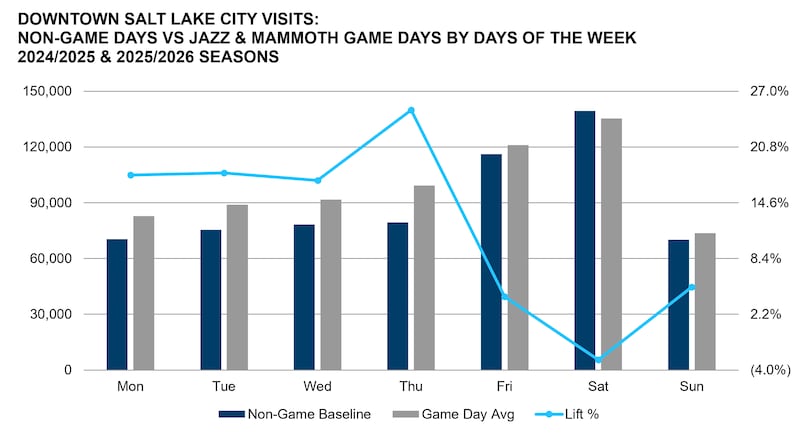
The Utah Jazz and Utah Mammoth are delivering consistent weeknight activation that the market has not historically had at this level, drawing thousands of fans into the downtown core on Monday through Thursday evenings for dining, parking, retail and entertainment spending that compounds over the course of a full season.
Downtown Salt Lake City’s restaurant and bar scene, supporting 347 restaurants and 36 bars, generated $558 million in taxable sales in 2025 for the 84101 and 84111 zip codes, more than 26% above the pre-pandemic 2019 figure of $440.9 million.
Arts, entertainment and recreation taxable sales in the downtown core reached $165 million in 2025, a 21% premium over 2019 — even after a modest pullback from the 2024 peak. Annual visitors to Salt Lake County surpassed 3.8 million in 2025, above pre-pandemic levels.
Music venues, festivals and performing arts
Annual visitors to Salt Lake County music venues surpassed 3.8 million in 2025, above pre-pandemic levels, drawn by a diverse ecosystem of festivals, amphitheaters and intimate venues spanning virtually every genre and demographic.
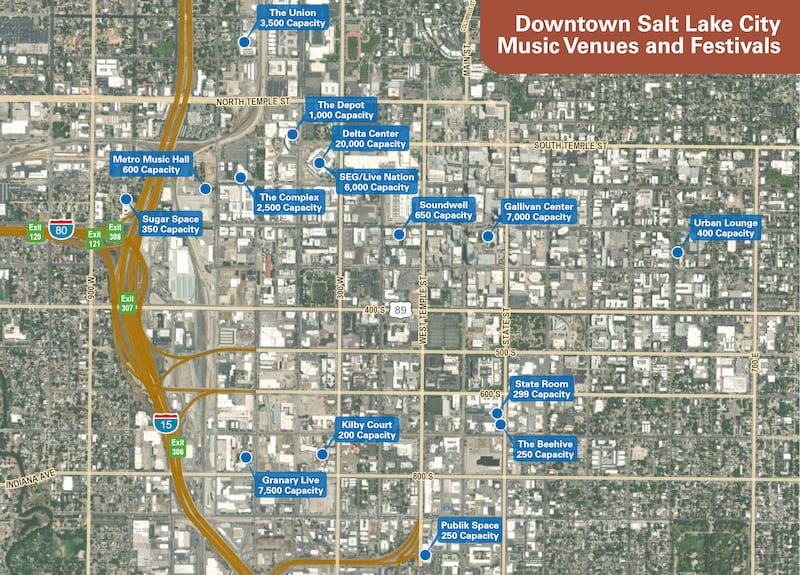
Salt Lake County’s festival and venue ecosystem generates hundreds of thousands of attendees each season. Kilby Block Party, RedWest, Red Butte Garden and the Twilight Concert Series collectively draw well over 200,000 attendees annually, complemented by a downtown venue mix that spans the 20,000-seat Delta Center down through mid-size halls and intimate clubs.
Two significant new venues in development will deepen that coverage further.
The SEG and Live Nation indoor venue, projected to seat 6,000 and draw one million annual visitors, fills a mid-capacity gap the market has long lacked. The Point’s Oak View Group venue adds another 5,000 indoor seats, collectively positioning Salt Lake County to capture a broader share of the national touring circuit.
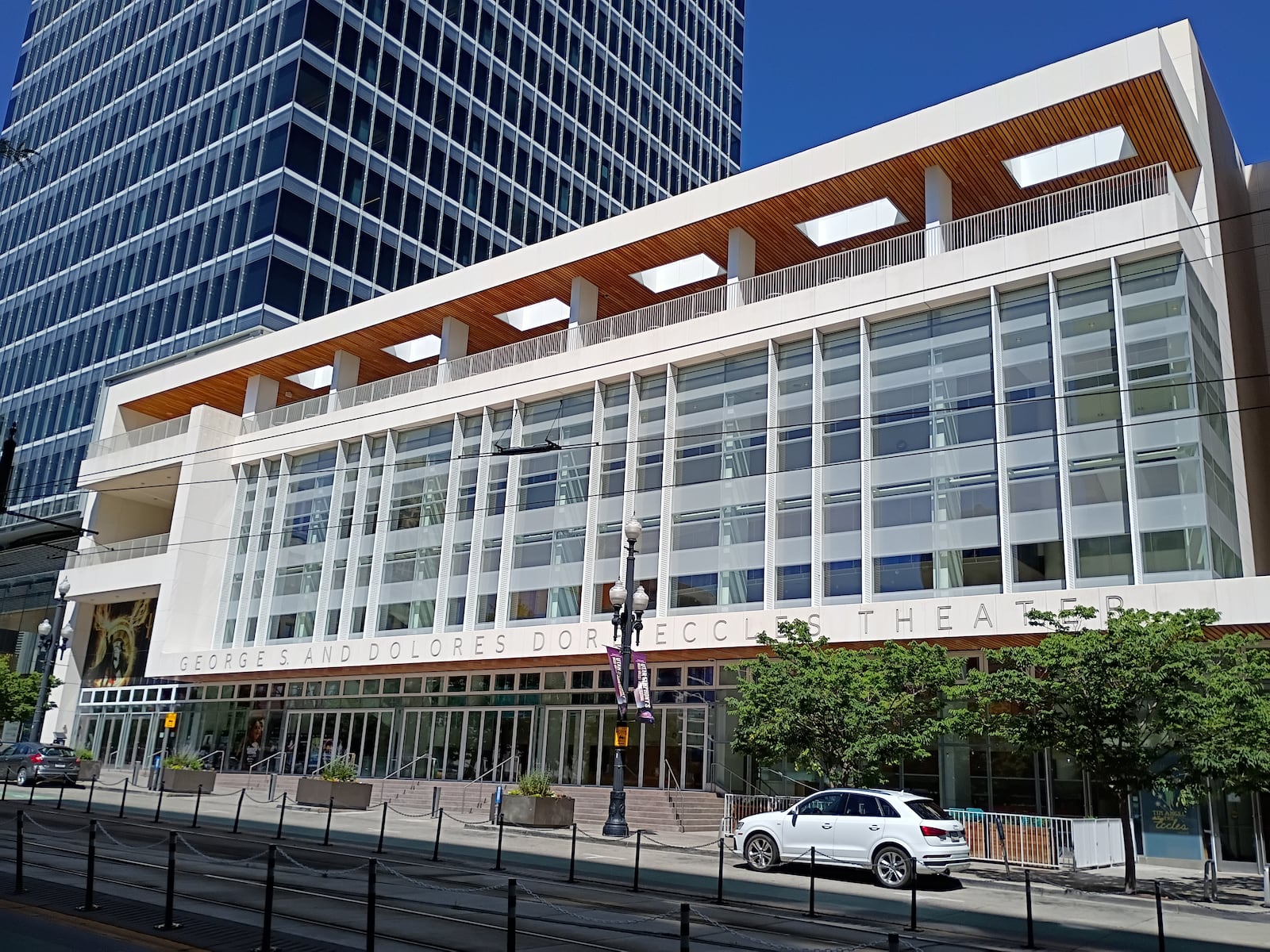
The performing arts sector is generating comparable momentum. The Eccles Theater’s 2025-26 season was its largest ever, while Abravanel Hall is undergoing a $100 million renovation as part of the broader SECC District redevelopment.
Across the city’s major performing arts venues, annual attendance figures are running consistently above pre-pandemic levels, reflecting sustained and growing appetite for world-class programming that extends well beyond any single venue.
Salt Lake City’s arts and entertainment ecosystem reflects a market that has moved well past the transient gains of post-pandemic recovery and into a period of structural growth.
Hospitality market
Downtown’s hotel market has absorbed more than 1,000 rooms since 2022 and posted two million rooms sold in 2024, a 42.9% increase over 2019. That demand is only going to intensify.
The 2027 Salt Lake Temple open house, the NHL Winter Classic, the 2034 Winter Olympics and the ongoing expansion of the Salt Palace Convention Center’s event calendar will provide robust opportunities for the hospitality market.
Salt Lake County has long been a growth market, and multiple billion-dollar-plus developments — along with a robust international events calendar — portend continued strong growth for decades to come.