
This story appears in the March 2026 issue of Utah Business. Subscribe.
Easy access to venture funding, a pro-business climate and a young, well-educated workforce make Utah one of the best places to be an entrepreneur — the second best state in the U.S., according to WalletHub. These factors power a high-pressure, risk-taking culture that begins with startup founders but doesn’t end there, as the many thousands who go to work for them also take significant personal and professional risks.
While becoming an entrepreneur in Utah may be “easy” for some, being an entrepreneur is not. Founder Reports says almost 90% of entrepreneurs consistently deal with at least one mental health issue — a rate the National Institute of Mental Health says runs about 400% higher than for all adults in the U.S. This, in turn, may contribute to Mental Health America ranking Utah second only to Oregon on its list of adults with any mental illness.
Bryce Herrera is a therapist at the Huntsman Mental Health Institute who specializes in treating men, including those powering Utah’s thriving tech scene. He says traits that may be good for launching a new venture exact a mental toll.
“There’s a psychology here that strongly associates success with hard work. If something isn’t working, you need to do more,” Herrera says. “That can be beneficial in business, but it often comes with a cost, emotionally and psychologically.”
The friendship deficit
When it comes to mental health, men and women have very different experiences on every level. According to a study published by the American Psychological Association, women are almost twice as likely as men to struggle with the internalized emotions of depression, anxiety and panic. Meanwhile, men are twice as likely as women to deal with externalized mental illnesses such as substance abuse and antisocial behavior.
This internal versus external dichotomy is inverted when it comes to how the genders respond to their mental health challenges.
“Men that I meet with do not process information the way my women clients do. Men are more likely to intellectualize things into a problem-solution orientation while women want to be seen, heard and understood,” Herrera says. “If you ask a male, ‘How are you feeling?’ what he’ll likely tell you is how he’s thinking. This is rooted in the difficulty men generally have tapping into the vulnerability they need to speak to their emotions, or even just ask for help in an emotional way.”
Herrera adds that for women, mental health self-care happens in the open, surrounded by supportive friends, while a man’s version of self-care typically takes the form of hobbies done in isolation, which makes them much less effective.
“When you’re young and in school or playing sports, social relationships come built into life,” Herrera says. “But as adults, friendships are harder to form, and if you’re not making an effort, you’re going to lose relationships over time and feel lonely. Every day, at least one male client will tell me they don’t have any friends and don’t even know how to go about making them. Or they’ll say they have a friend at work, but they never hang out together. On the other hand, my female clients have all sorts of different friends.”
Curing isolation with brotherhood
The impact of loneliness on both physical and mental health is devastating. It’s the equivalent of smoking 15 cigarettes a day and significantly increases the risks of suicide, depression and even dementia.
With the stakes so high and the cultural and psychological barriers to adult men forming organic friendships so formidable, some are taking steps to engineer organic connections, akin to how an enzyme facilitates a chemical reaction that would have happened eventually, despite the body’s need for it right now.
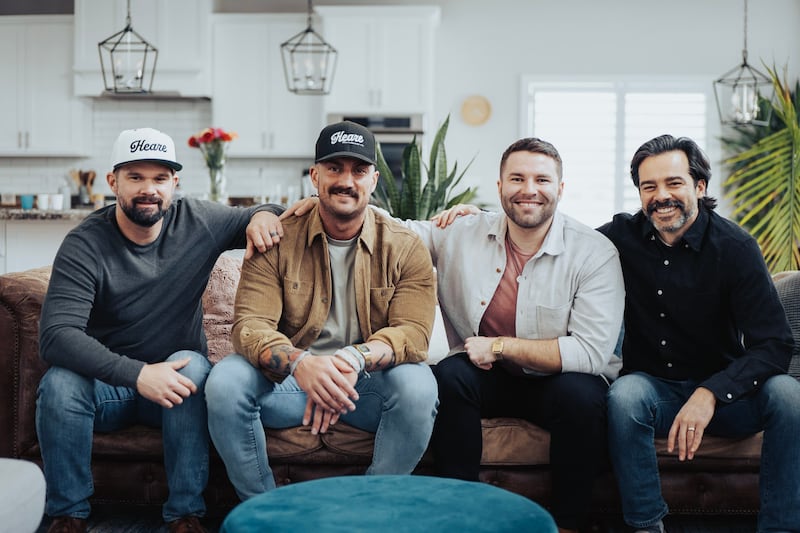
“After going through my own mental health struggles, I was eventually able to get some help and the resources I needed,” says John Moore, co-founder of Heare Brotherhood, a Utah-based men’s mental health and personal development community. “Then I noticed guys on LinkedIn like Nick Stagge, Levi Lindsay and Paul Shin opening up about their own journeys and helping normalize conversations about mental health. I knew I wanted to help, so I started sharing mine.”
It was that willingness to be vulnerable on LinkedIn — where portraying perfection was the norm — that attracted Justin Brey, leading Brey and Moore to team up on an awareness-raising apparel brand. Soon, Michael Allen and Jason Rogers got on board.
“We kept posting about how it’s common for men to experience mental health struggles like burnout and addiction,” Moore says. “And because it was still very rare to see people talking about these things on social media, it helped spark the conversation, and we got real traction with people wanting to get involved, volunteer and help. That’s when we realized that we needed to build a community.”
The word “Heare” in Heare Brotherhood is a mashup of “here” and “hear,” symbolic of members’ commitment to being present and listening.
What the research shows
A virtual base of support is better than none at all, but if the goal is to feel more connected and less lonely, interactions need to be face-to-face, according to human connection researcher Andy Proctor, Ph.D.
In one study, Proctor had research subjects answer 36 questions designed to increase feelings of closeness between people. In one group, a stranger asked the individuals questions in person, while the other group interacted with a chatbot. Proctor measured stress levels during the interaction and feelings of loneliness before and after. He found that while talking to a stranger tended to be more stressful, it was also significantly more effective at reducing feelings of loneliness than conversing with a chatbot.
The study, conducted on the campuses of Brigham Young University (BYU) and the University of California San Diego (UCSD), revealed something instructive that Proctor hadn’t specifically been looking for: BYU students reported lower baseline loneliness levels and experienced less stress than those observed at UCSD.
“BYU is an anomaly in that enrollment requires regular church attendance, which equates to consistent, active, in-person participation in a community with high social connection,” Proctor says.
On that topic, Proctor co-authored a study examining how different types of events affect loneliness — comparing in-person and virtual gatherings, solo versus group attendance, active versus passive participation, and whether events recur regularly.
The study concluded, “Loneliness has been described as a modern epidemic, but fostering a sense of social connection can offset the experience and negative impacts of loneliness. … Regularly attending in-person, engaging events with others may be an effective and accessible way to enhance social connection.”
AI can’t replace real connection
While Proctor’s research has conclusively shown that face-to-face interaction is much better at reducing feelings of loneliness than interaction with a chatbot, the chatbot did have a positive impact on loneliness. Proctor thinks AI “friends” could be useful as a short-term tool or supplement to real relationships, but not a replacement.
Herrera is less optimistic about AI’s effect on mental health generally and about its ability to support his work specifically.
“I tell them to think of therapy as another form of exercise, strengthening emotional muscles. And like going to the gym, starting out can be uncomfortable, but the discomfort is a sign you’re doing it right and getting stronger emotionally.”
— Bryce Herrera
“I do not believe these chatbots will be very effective tools for therapy because they’re programmed to tell users what they want to hear. That’s not how real relationships work. As a therapist, I often disagree with my clients because that is how real relationships work and therapy is supposed to be relationship practice,” Herrera says. “I’ve asked clients questions about themselves, and they say they don’t know the answer and will have to ask ChatGPT. They’re filtering their lives through this technology, and it’s robbing them of authenticity.”
What Proctor proved statistically, Moore and his co-founders already felt intuitively. They were determined to incorporate the principles of in-person, active, regular group activities into their budding brotherhood.
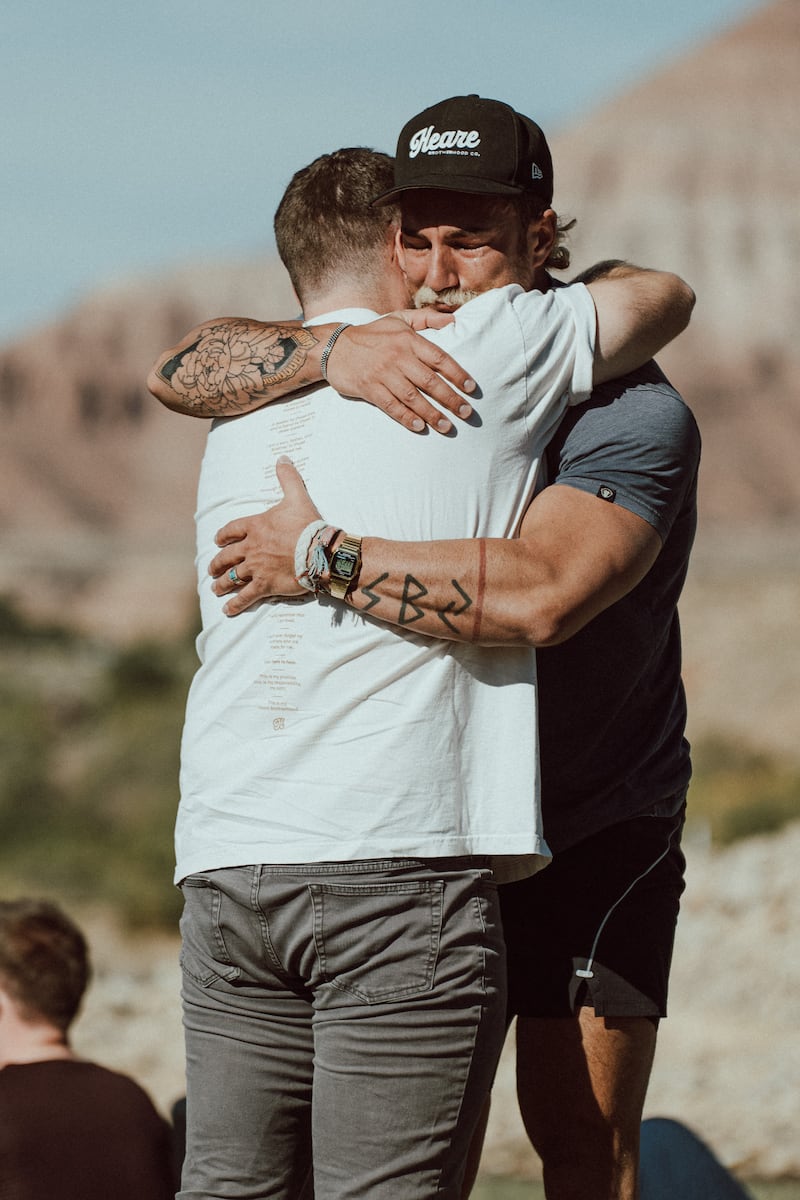
“Before joining us, Mike [Allen] had been organizing men’s retreats in Midway, and he started leading in-person gatherings, like cold plunges, holotropic breathwork, mindfulness and meditation,” Moore says.
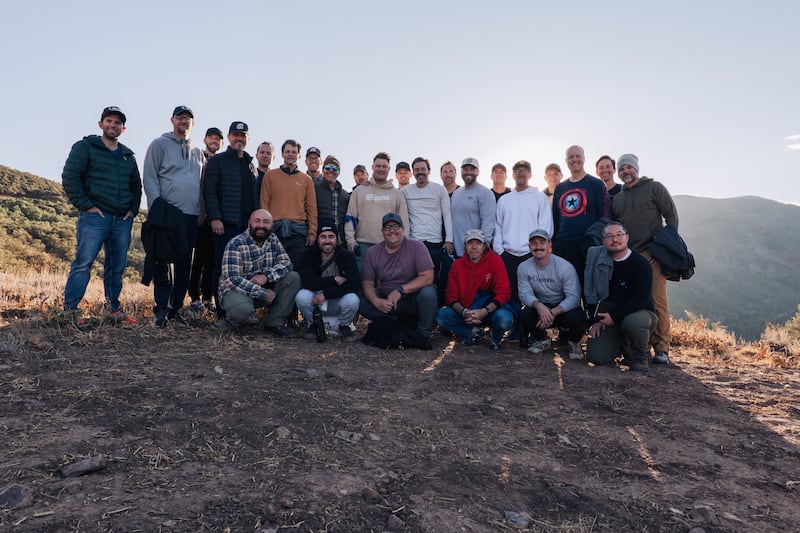
Within a few months, Heare Brotherhood had grown to 7,000 members, composed of men from 30 countries, most of whom found the group on LinkedIn. Moore says the typical member is a millennial, and many are corporate leaders or scrappy entrepreneurs.
“Turns out what started as a little Utah thing resonated with men everywhere. We hosted some virtual gatherings that would have men from eight or nine countries join,” Moore says.
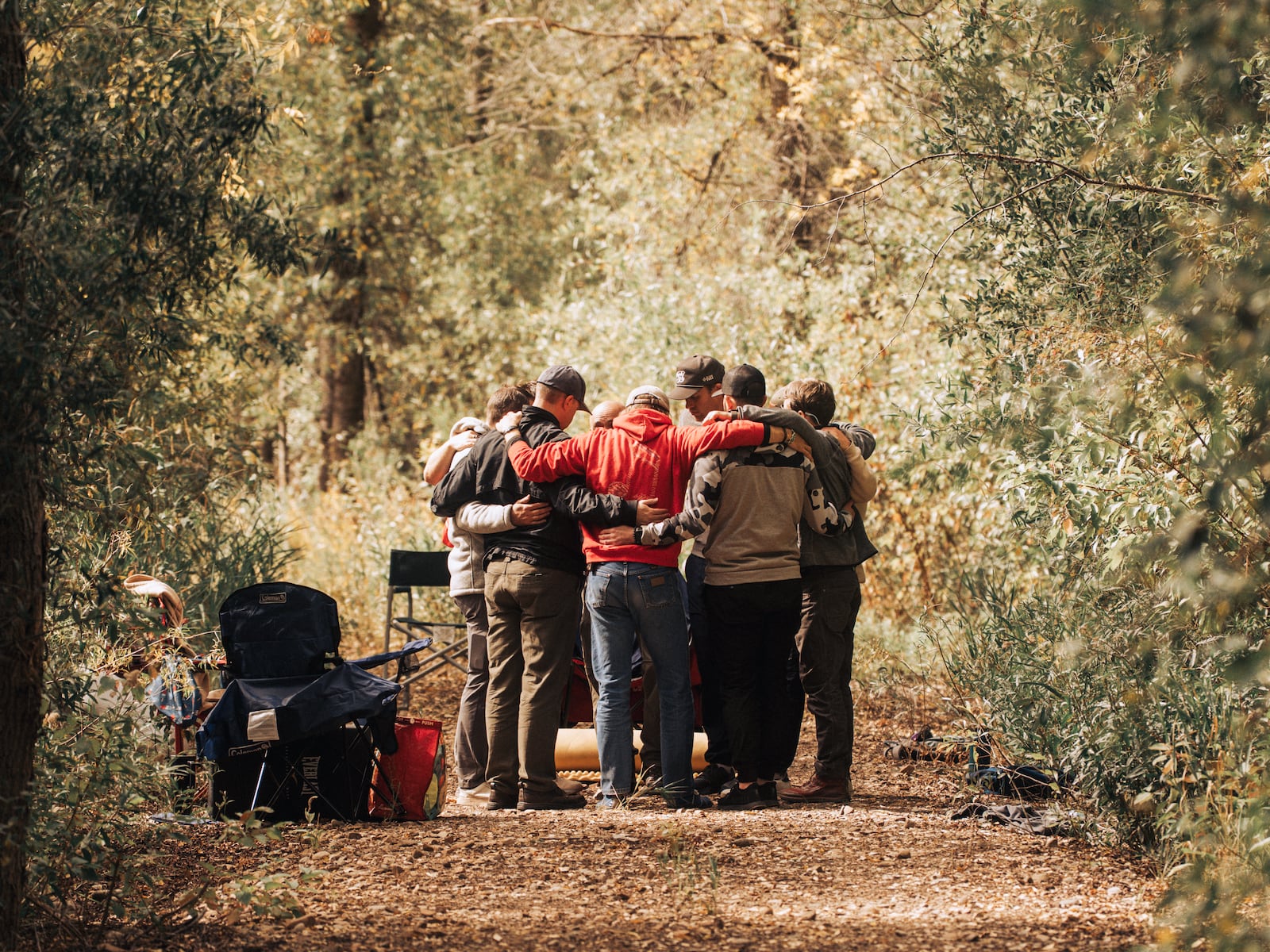
Today, Heare Brotherhood is organized around a few transformational weekend retreats each year, held in dramatically picturesque settings, usually amid red rock cliffs or pine-covered mountains.
Connection over Costco fare
If Heare Brotherhood’s paid retreats are on one end of the men’s mental health spectrum, the Provo-based Men’s Mental Health Community Club’s (MMHCC) Costco meetups are on the other, proof that communities simply need to meet members where they are.
“It started with me and my buddies,” says BYU student, MMHCC organizer and self-described entrepreneur Jaxon Smith. “We’d always try to hang out when we’re able to get together because everyone’s doing school and work, and so we figured out a time where we would all meet at Costco to eat at the food court and talk. I think we picked Costco because it’s so cheap. We’d meet there a few times a week and it turned into something we all really looked forward to.”
While the group was still under the radar — and not yet much of a group — Smith made a simple promotional video that circulated.
“Ten people came the next week, then 18, then 25, and then low 30s,” Smith says. “Then some reporters heard about it, and we made the news, and then it took off. Every time a news story runs, I get a ton of messages from men who want to get involved, but also plenty from mothers and wives saying a man in their life really needs this. At first, we were all around 20 to 24 years old, but now the age range runs from 18 to 65.”
Given the group’s growth and the limited seating capacity of Costco food courts, Smith is taking advantage of offers from venues as diverse as a barbershop and an auto repair shop, offering to host events for 100 or more men.
When Smith talks about the community he created, he does so with humility and evangelical zeal.
“It almost feels like a spiritual calling, like I’ve been given this mantle and an opportunity to help people lead happier lives,” Smith says. “I’ve been blessed as people enter my life who I didn’t know I needed. To see how much my life is changing, along with other men, is one of the greatest blessings for me personally. And this organic growth is proof that there was a huge void that needed to be filled.”
No substitute for hard work
Herrera says the same need to fill the void in men’s lives has spawned a wave of self-help books, which he has mixed feelings about.
“I would caution men to be wary of some of the books being published lately,” he says. “I think the authors are well-intended, but I find that when they insist masculinity is just about being tough and strong, they keep men stuck by preventing them from being vulnerable, which is where real progress is made. I’m a therapist, and so I have my biases, but I do believe therapy is where we really learn about ourselves as men and what it takes to be in a relationship. Because every man who struggles with loneliness and vulnerability struggles for his own reason.”
For the same reason, Herrera also cautions against taking the advice of “therapy influencers,” whose generalizations are ineffective because they lack vital context.
Herrera adds that many entrepreneurially driven men only agree to therapy after an ultimatum from someone close to them, often prompted by substance use to compensate for unmet emotional needs. Many say they previously justified avoiding professional help by claiming the gym was their therapy.
“I tell them to think of therapy as another form of exercise, strengthening emotional muscles. And like going to the gym, starting out can be uncomfortable, but the discomfort is a sign you’re doing it right and getting stronger emotionally.”