
The indie film business is broken. Audiences aren’t taking a chance on small projects. Filmmakers are overworked and underpaid. Distributors have an underdeveloped product. Investors are getting burned. At least that’s what Daren Smith, Utah-based independent film producer and founder of Craftsman Films, has observed.
He says independent films are predestined to depend on festivals and studios rather than having a fighting chance to move from production to theaters. While supporting four indie films, including The Carpenter (2023) and Faith of Angels (2024), he noticed aspects of the strategy that support creative projects weren’t working, yet filmmakers return to them again and again, from funding to marketing.
Going into the launch of his fifth movie, “Brotherhood: A Cinematic Musical,” Smith is putting his own indie film playbook to the test for the first time, much of which he documented in his most recent self-published book, “Blockbuster: How Independent Creators Can Build Massively Profitable Businesses.” By the end of the musical’s run in theaters, Smith hopes to prove independent films can be designed for profitability before even writing the script.
“I looked around and I [thought], ‘These are solvable problems. Why is nobody solving this?’” Smith says. “I decided, I guess it’s on me because I can’t keep doing it the old way.”
Starring local Utah talent, including Casey Elliott, co-founder of GENTRI and PENY, “Brotherhood” is about next-door neighbors in America — one a U.S. citizen and one a Mexican immigrant — who work through perceived differences to discover their commonalities and shared humanity. Ross Boothe, who Smith met in college, wrote, composed and directed the musical to offer commentary on current sociopolitical immigration policies and events.
“If the message that goes out is that there’s a white guy from a very red state who really loves the Latino community, but even beyond that, loves the human race enough to say we all deserve love and kindness and respect, then I’ll take that as a win,” Boothe says. “We need a lot more people who look like us who are willing to say that in the world today.”Smith says unifying messages like the one this film shares — messages that are timely and align with a ripe audience — are exactly what his indie film strategy should be applied to. If there is a message a creative wants to share, it should be able to find the right audience and achieve profitability.
That audience doesn’t have to be enormous. Indie films don’t need to rival studio blockbusters with 100 million viewers to be profitable. In many cases, a few hundred thousand is enough.
To accomplish this, flipping the four-point indie film strategy script is necessary, he says. 1) The audience should be engaged before filming to supercharge marketing efforts. 2) Filmmakers need to be treated with respect as partners and vendors. 3) Distributors need to know the movie is marketable and in demand. 4) Lastly, investors are investors. They need a return, no matter the product.
1. Find the audience before production
You wouldn’t create a product without evidence that someone wants to buy it. Boothe believes the same rule should apply to independent films. Before committing to a project, filmmakers should determine whether its concept can galvanize a specific group of people versus assuming an audience will appear after the film is made.
“Is there data that [tells us] there is an audience for this? A crowd that wants what we say we’re going to build?” Boothe says. “If we can’t answer that question clearly, then maybe we ought not start.”
Once a film passes that test, audience-building begins immediately. Smith hires the marketing team as soon as a project is greenlit, giving it the full production cycle to attract potential viewers.
For “Brotherhood,” that meant regularly sharing content that documented the film’s development from pre-production onward. The goal was to draw the right people to the project, bring them onto an email list and give them reasons to remain invested through the premiere.
“We don’t have $100 million to spray and pray on ads on Meta platforms and put billboards and weird activations in Times Square,” Smith says. “We have to tell people one at a time, ‘Here’s a movie I think you would be interested in. It’s coming out next year.’”
The filmmakers also partnered with nonprofits, community groups and other organizations whose work aligns with the movie’s message. Those relationships gave Brotherhood access to existing networks of people already engaged in the issues the film explores, while giving partner organizations a platform for their work.
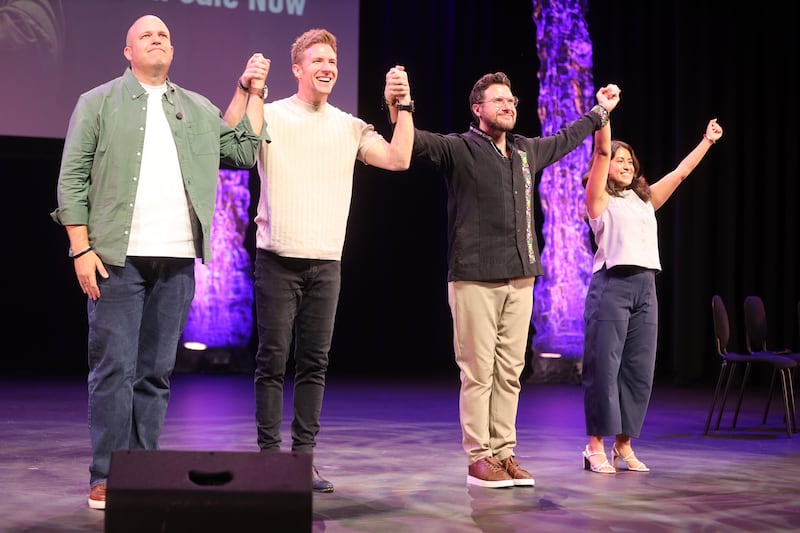
After filming wrapped, that process moved offline. Ahead of the movie’s Oct. 9 theatrical release, the team planned a tour spanning 20 cities and 21 events, including 18 tour stops and three approaching premieres: Los Angeles on Sept. 23, Salt Lake City on Sept. 29 and New York City on Oct. 1. At each stop, the filmmakers show scenes, perform songs and hold conversations with local leaders who connect with the film’s message.
The tour is designed to turn interested viewers into committed supporters who will buy tickets and generate word of mouth. Depending on the market, a successful event might attract a few hundred people, giving the filmmakers a concentrated base of support before the movie reaches local theaters.
“We talk to everybody,” Boothe says. “We shake their hands, and we look in their eyes. We cry with them. We love them. … We feel connected to them. And maybe that’s the real silver bullet. … Human connection is the thing that makes businesses go, that makes projects like ours go. It makes everything go.”
The approach is also relatively inexpensive. Because the production money had already been raised and sponsors helped cover individual tour stops, the “Brotherhood” team could generate publicity, reach influencers and sell tickets without pulling heavily from the marketing budget.
“That’s not a ton of money out of pocket, but we get crazy marketing from it,” Smith says. “It’s really high leverage — high return for low cost.”
2. Treat filmmakers like partners
On most film sets, the cast and crew work at least 12-hour days over the period of time the budget permits. “Brotherhood” was filmed over 23 days with the crew generally working 10-hour days instead of the industry-standard 12. Crew members were still paid for 12 hours, and key department heads received the same flat rate rather than compensation based on a perceived hierarchy of importance.
“I think it’s about respecting the craft that they’re bringing to the table,” Smith says. “They’re saying, ‘I want to give you my talent and my time and my attention and my energy.’”
The difference was meaningful to crew members accustomed to much longer days. Smith recalls a makeup artist telling him it was the first time she had worked on a film and still been able to regularly eat breakfast or dinner with her husband.
“She was to the point of tears that it mattered that much,” he says.
Making independent film more sustainable also means reconsidering how the people behind the camera are treated. Smith says filmmakers are routinely treated as replaceable labor, even though the final product depends on their skill.
Smith also structured backend participation into the production, allowing crew members to share in the upside if the movie makes money.
Smith believes part of his job as a producer is assuming the uncertainty that would otherwise distract the creative team. The producer makes the difficult financial and operational decisions, he says, so the director, actors and crew can concentrate on making the best film possible.
“If the director is freaking out about finances, they can’t do their best creative work,” Smith says. “If the actors feel like they [aren’t] compensated fairly, they can’t do their best creative work.”
For Smith, that responsibility goes beyond finishing a movie on time and within budget.
“As a producer, my greatest joy in the process is providing and protecting the creative space for these artists to do their best work,” he says.
3. Give distributors proof of demand
The next part of Smith’s model brings distributors into the process earlier. Instead of completing a movie and then asking someone to sell it, he wants filmmakers to understand from the beginning what the market will support.
That may mean discussing the film’s budget, genre, cast and commercial positioning with distributors before production begins. Their feedback can reveal whether a project is structured in a way that gives them a realistic opportunity to sell it.
Too often, he says, filmmakers begin with an idea, gather whatever money is available and make the project they can afford, only to find distributors do not see a clear commercial path for it.
Even a marketable independent movie enters negotiations at a disadvantage. Major studios offer recognizable actors, large advertising campaigns and leverage created by a slate of films. An independent producer asking for screen time can’t offer those assurances, Smith says.
The audience-building strategy behind “Brotherhood” is intended to eliminate the heartache for filmmakers and headache for distributors. Ticket presales in target markets give Smith evidence that viewers are already prepared to attend. Instead of asking a theater to take a chance on an unknown movie, he approaches chains such as Cinemark or Megaplex with paying customers.
“We can say, ‘We’ve already sold the tickets. You don’t have to take a risk on us. We just need 10 showtimes,’” Smith says.
That is why Smith does not define independence as working alone. He defines it as building enough leverage that a film does not depend on a studio, streamer or distributor to rescue it.
“If we try to act like studios as independent filmmakers, that’s where we keep bumping up against the hard brick wall,” he says. “[We] have to act differently.”
4. Give investors a reason to reinvest
Smith has personally seen a series of disappointing film investments make backers wary of investing again. Most of the investors he approaches have lost money on a film or know someone who has.
“Most of the people I’m raising money from are from Utah, and 90% of the investors I talk to say, ‘I don’t do film anymore. I did it once. I’ll never do it again,’” Smith says.
Part of the problem, he believes, is that filmmakers and investors speak different languages. Filmmakers arrive with images, scripts, creative teams and director statements. Investors want to know how much capital is required, how it will be used, when they might see a return and what risks they are assuming.
“We’re not pitching a creative project,” Smith says. “We’re pitching a business opportunity. And business opportunities have projections and numbers and financials.”
Learning to make that distinction changed his conversations. Rather than asking someone to support a piece of art, he presents a financial opportunity that “happens to be a movie.” Then he explains the strategy that puts paying viewers in seats.
Smith founded Craftsman Films and began building a film fund around that idea. His goal is to both find new investors and create investors willing to support multiple projects because they continue to see returns.
“If they were willing to put a million dollars in on a movie, they’re willing to do it again as long as it made them money, or at least didn’t lose them money,” he says.
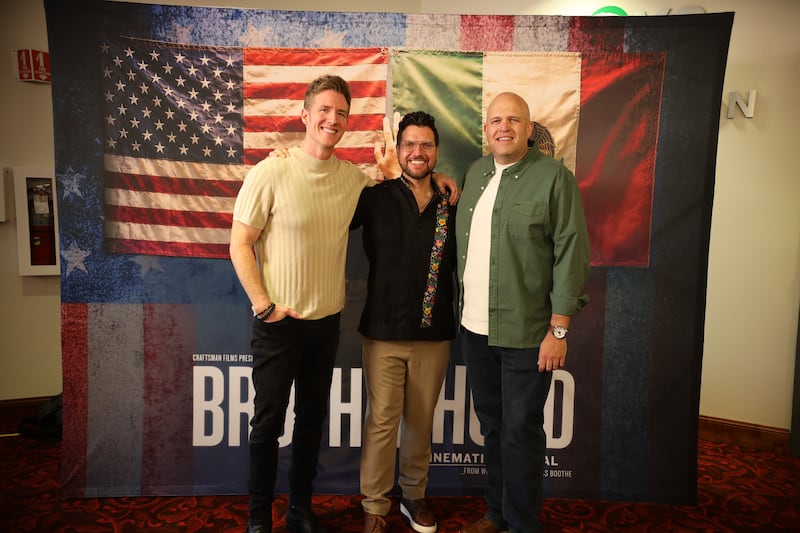
Whether all four pieces of Smith’s strategy can work together remains an open question, but seems to have promise based on the traction it’s seeing applied to “Brotherhood.” The theatrical and streaming returns will provide the real test.
Smith is not claiming to have solved independent film profitability yet. He is testing whether filmmakers can stop waiting for the traditional system to work for them and build something more sustainable in its place.
“These are solvable problems,” he says. “So, why is nobody solving them?”
