
This story appears in the August 2026 issue of Utah Business. Subscribe.
Tuacahn Amphitheatre proved its might as a creative force the night the lights went out in Padre Canyon.
Disney’s “Tarzan,” battered by caustic criticism, had closed on Broadway after a 14-month run. So Thomas Schumacher, then president of Disney Theatrical Group and the show’s lead producer, was surprised when Tuacahn artistic director Scott Anderson called before the 2010 season.
Anderson said he loved Phil Collins’ music and the family-friendly story so much, he wanted Ivins, Utah, to host the regional premiere. The Disney licensing team knew little about Tuacahn then, Anderson says, but he kept calling, kept sending photos and videos. Kept it up for a year, in fact.
When Disney Theatricals finally gave Tuacahn the licensing rights to perform “Tarzan,” Schumacher made his first trip to Padre Canyon. Just as the show was about to start, power in the canyon went down. No lights, no sound.
“We’re not sure if we’re going to have a show,” Tuacahn CEO Kevin Smith recalls. “So we hold the show for 20 minutes, and in the meantime he’s asking people sitting around him where they’re from. There’s a person from California sitting behind him, a person from Salt Lake City next to him. He couldn’t believe it was sold out.”
Power returned, the show started and, moments later, out of the dark desert night, Tarzan descended on a rope line from the dramatic 1,500-foot red-rock cliffs of Padre Canyon.
“The audience whispers oohs and ahs in concert, and I experience instantaneous chills,” a reviewer wrote at the time. The Las Vegas choreographer who designed the aerial scenes told the Las Vegas Review-Journal, “Broadway was just a green box. It didn’t look like a forest. … ‘Tarzan’ was the show Tuacahn was built for.”
Every performance sold out, and “Tarzan” became the highest-grossing show in Tuacahn’s 15-year history.
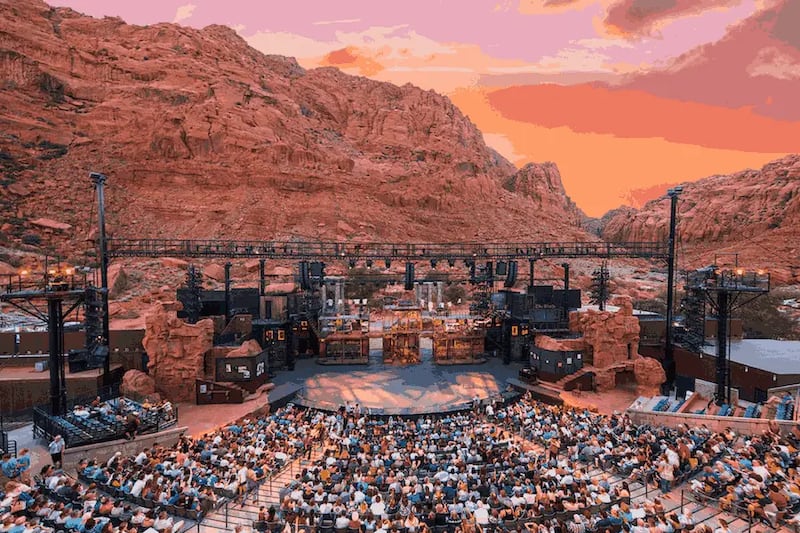
Smith believes that night in 2010 marked Tuacahn’s coming of age. Tuacahn’s partnership with Disney blossomed, and Disney Theatricals rewarded Tuacahn with the regional premiere of “The Little Mermaid” in 2011 and “Mary Poppins” in 2013.
“Tuacahn has sometimes had these weather events happen,” says Smith, “and I always remind people: It’s just this canyon telling us that it’s not going to be easy, but if you keep working at it, in the end it’s going to be an even better product. So just stick with it.”
Four lessons from Tuacahn’s journey
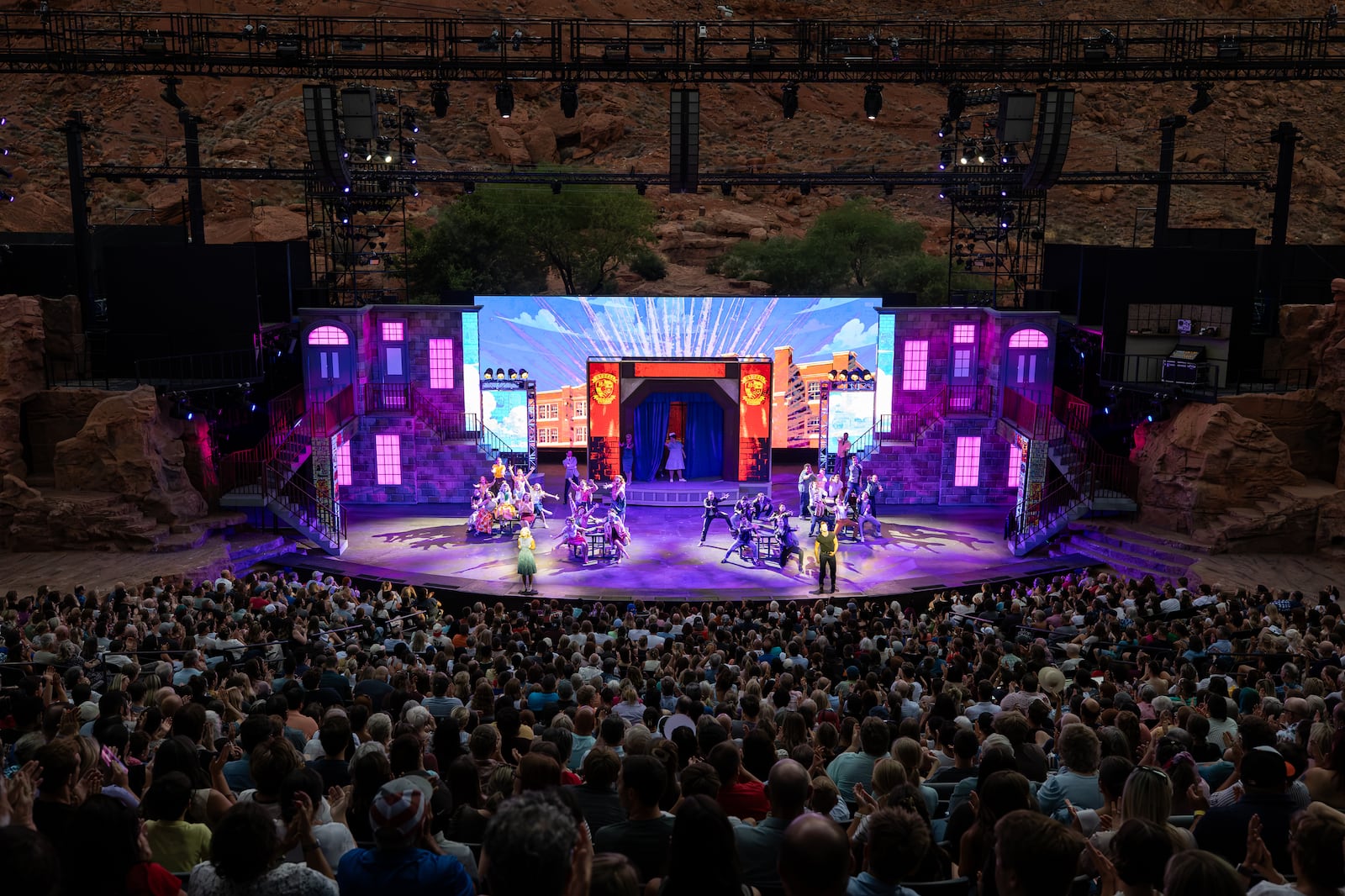
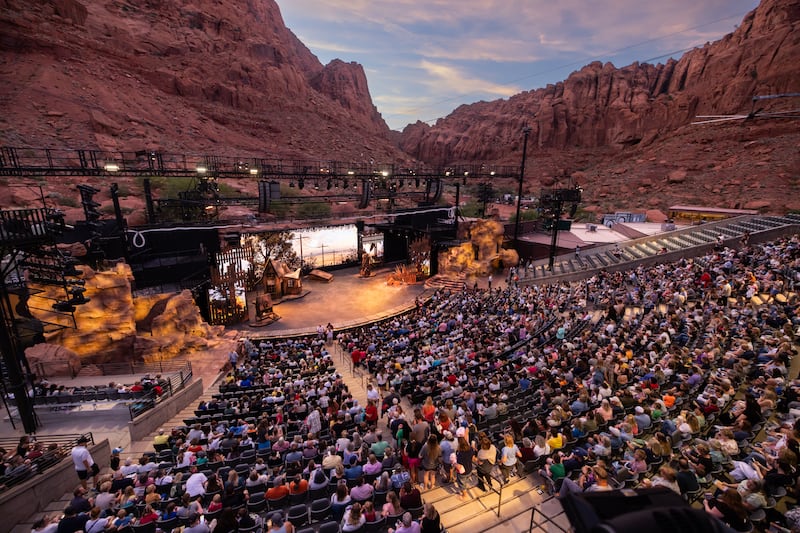
Tuacahn, founded 31 years ago, has grown into Utah’s largest professional theater. In a desert town with a population of 12,000, Tuacahn draws 350,000 guests annually from all over the world to its 2,500-seat amphitheater and 428-seat indoor theater.
On April 8, 1995, Gordon B. Hinckley, the newly installed president of The Church of Jesus Christ of Latter-day Saints, ascended Tuacahn Drive in a horse-drawn carriage and dedicated the amphitheater. As the sun set, the Tabernacle Choir at Temple Square sang “Come, Come, Ye Saints,” and as the harmonies rolled down the canyon, crystal clear, guests marveled at the natural acoustics.
Anderson and others believe Hinckley delivered a prophecy that day.
“He said in his blessing that this would become a place millions of people would travel to, and they would tell other people,” Anderson says.
To achieve that vision, Anderson says, Tuacahn needed to dream big and commit to making itself a destination for visitors. Smith, the CEO, has walked that journey with Tuacahn for 28 years, and Anderson for 22 years. The creative team they’ve brought together, known for big productions and dazzling effects, was recognized in May when USA Today named Tuacahn one of the 10 best amphitheaters in the United States.
Here are four lessons creative organizations can learn from Tuacahn’s success:
1. Be what you believe, and the right relationships will follow
Anderson figures there are maybe 30% of all Broadway shows suitable for Tuacahn’s mission of family-friendly entertainment. Some licensing shops are willing to make script changes; others are not.
When he fell in love with “Jersey Boys,” Anderson knew the Broadway version had so many expletives, it could never play in Padre Canyon. He reached out to the licensing house, and it responded with a script cleaned up for Tuacahn.
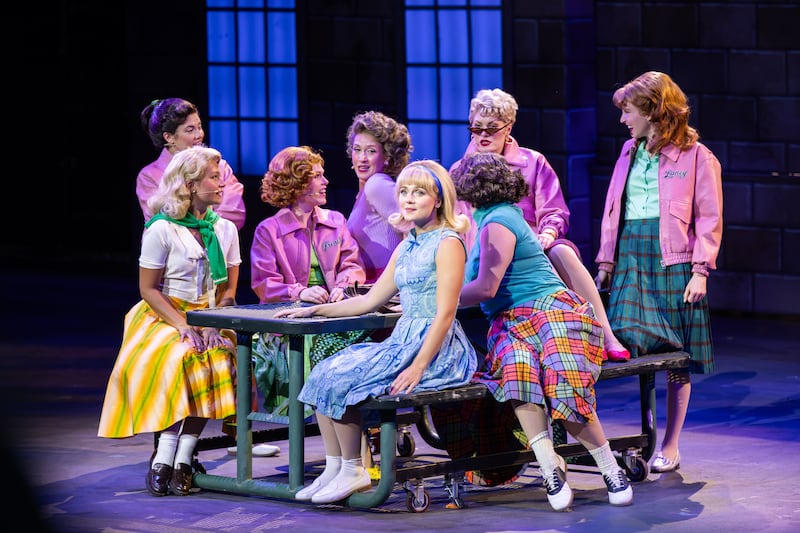
Anderson made a few more revisions, and what he calls a “PG-13 version” of “Jersey Boys” hit the Tuacahn stage for the 2024 season. Tuacahn’s emergence as a box-office behemoth has given it leverage with the licensing houses.
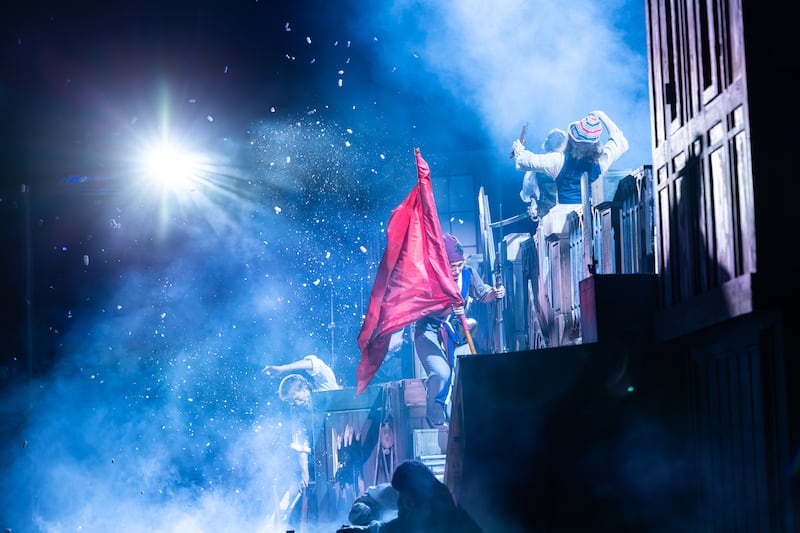
“Our production of ‘Les Mis’ [Les Misérables] generated as much money as some of the largest regional theaters in the United States,” Anderson says. “Relationships with the licensing houses and producers are where it all gets started, and those are important, but money really talks when it comes to getting these houses to notice your theater.”
Tuacahn aspires to deliver more than entertainment. Its team pursues productions that prompt guests to leave the theater reflecting on principles from the stage that have meaning in their lives.
“We’re trying to create meaningful and uplifting experiences for families that may change their perspective, may improve their outlook on life,” says Smith. He adds, “We live in a community that appreciates and supports the family. We don’t apologize for that because it’s part of who we are.”
2. Strive to thrive, not to survive
Flash back to 2004. Tuacahn hired college actors, and its season had to end in August to allow students to hurry back to school. Annual attendance hovered around 40,000.
Anderson interviewed for the artistic director job that year, and he remembers Tuacahn co-founder Hyrum W. Smith asking him what he thought of the college-based approach.
“I’d change that immediately,” Anderson told him. “I’d go to New York, and I would up our equity contracts and hire union actors. Let’s build this place as a destination, rather than just a rumor.”
Smith liked the answer, and Anderson took the job. There was just one problem.
“Little did I realize we were broke at the time,” Anderson says with a laugh. “The first time I met Kevin Smith, he was COO, not CEO, and he was in the fetal position under his desk. He said, ‘We’re broke. We have no money. We’ve drawn our line of credit.’”
The board and management team raised more money and professionalized the theater. Tuacahn added auditions in Las Vegas, Los Angeles and New York. It staged multiple shows each summer, enabling it to sell season tickets, which brought in revenue up-front, and attracting tourists who could see different shows on back-to-back nights.
Randal Keith may be the best example of how far Tuacahn has come.
Keith starred as Jean Valjean in the Broadway production of “Les Misérables,” and he played the Phantom in the first national tour of “The Phantom of the Opera.” He auditioned in Las Vegas for the 2014 season.
He remembers driving up Tuacahn Drive on his first day and, as Padre Canyon revealed itself around each turn, thinking, “This is not real.” He says, “That first year, I really fell in love with not just the theater but the whole town and the people here.”
Now jump to 2021. Tuacahn was staging Disney’s “Beauty and the Beast,” and Keith called Anderson, letting him know he was available and wanted to perform at Tuacahn.
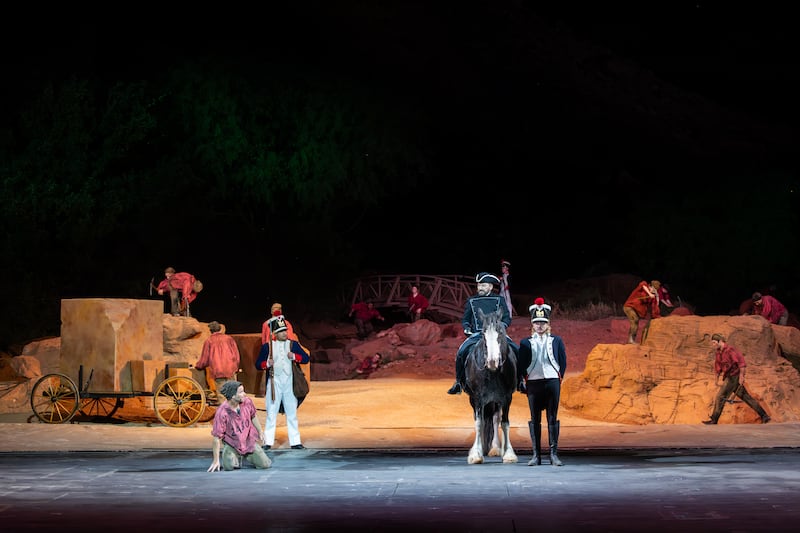
“We don’t have a role for you,” Anderson says.
“I don’t care,” Keith told him. “Put me anywhere.”
So it was only through relentless persistence that Broadway star Randal Keith got to play — wait for it — a cheese grater in “Beauty and the Beast.” The next year, he and his family moved to St. George.
3. Give creatives a voice in decisions, and talent will beget talent
Hyrum Smith hired Anderson because he spoke his mind and had grander visions for Tuacahn.
“I wanted to expand this place, and everyone looked at me like I was crazy,” recalls Anderson. “But not Hyrum. Hyrum said, ‘Scott, do what you need to do. We’ll find the money.’”
Today, when Anderson brings in professional actors and Broadway directors, he follows Hyrum’s example: Find talented people, and give them space to solve creative problems.
“Scott fosters an environment where the creativity flourishes,” says Kevin Smith. “There may be something in the script that doesn’t match our family filter, and he’ll ask, ‘What are we going to do about that?’ He’ll leave it up to the directors and allow them to work through things. It allows great ideas to come to the surface that probably wouldn’t have otherwise.”
Tuacahn’s investment in both onstage and offstage talent — including on-site housing it built for 78 actors and crew members — has paid off. According to its most recent financial reporting, Tuacahn generates over $25.2 million in annual revenue, with $15.7 million in net assets, and according to Washington County, it produces $125 million in economic impact.
To direct the adaptation of “Jersey Boys,” Anderson brought in Aaron De Jesus, a BYU graduate who performed the role of Frankie Valli in New York and on the national tour.
“He knew the show cold,” Anderson says. “He said, ‘I can direct the show you need.’”
Hiring star talent has a multiplier effect for Tuacahn. After being hired to direct, De Jesus convinced Candi Boyd, who played all three female roles on the national tour, to be the show’s choreographer.
“When Aaron asked me to join him in this, I could not have jumped higher at the opportunity,” Boyd says. “Tuacahn is one of those theaters you always hear about.”
4. In a creative organization, everyone is part of the show
On show nights at Tuacahn, there is staff in the box office selling tickets, in the gift shop selling merchandise and at the concession stands serving food and drinks. But working behind the scenes doesn’t exempt them from Tuacahn’s mission — productions that match the majesty of the canyon.
“If your food service matches the majesty of the canyon, and your customer service matches the majesty of the canyon, then customers are going to feel they’ve come to someplace special, and they’ll want to come back,” says Kevin Smith. “I’ll sometimes remind people, if you hand somebody a soda, and it’s flat and it doesn’t taste good, that’s not a soda that matches the majesty of the canyon.”
Anderson and Smith agree that the work hasn’t always been easy. Tuacahn endured a season without shows during the 2020 pandemic, although it rebounded faster than other theaters with a strong 2021 season that earned a record surplus of $6.6 million. Then there was the wind storm that blew through the canyon like a freight train. Smith and others sprinted to the amphitheater to move equipment into storage, and when a gust became a squall, he jumped on the rolling equipment and careened 30 yards down a hill and off a curb but walked away without a scratch.
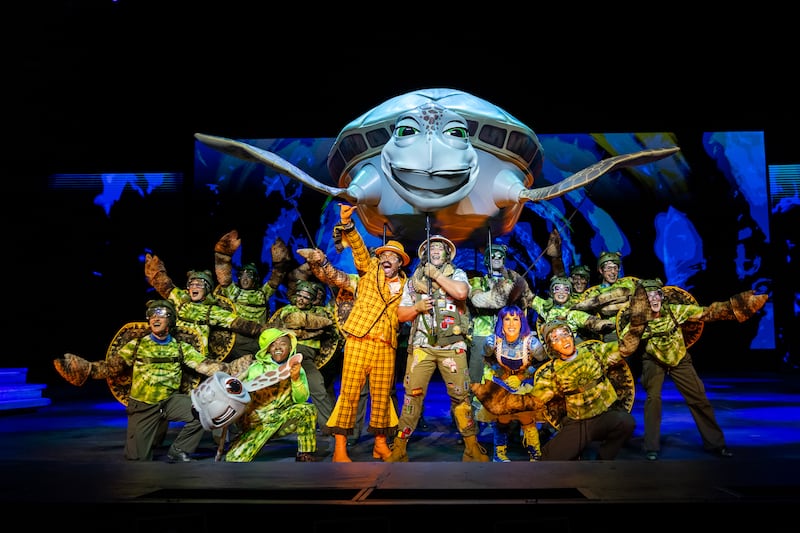
Performing their jobs in a way that reflects the majesty of the canyon is more than a mission statement to Smith and Anderson; it’s the fulfillment of Hinckley’s vision 31 years ago: “Millions in years to come will be touched in their hearts by that which will be enacted before them as they sit in this beautiful theater under starlit skies.”
Smith carries those words with him up Padre Canyon every day.
“People want to get away from the struggles of life sometimes and be entertained,” he says. “And we hope in some small way we’re contributing uplifting entertainment that adds to their quality of life. That’s something I hope people in the community see. They don’t have to travel to faraway places to see great theater. We have it right here in Utah.”
