

This story appears in the December 2025 issue of Utah Business. Subscribe.
Utah-based Rodatherm Energy Corporation has revolutionized the geothermal energy equation, and venture capitalists have taken note. With pilot projects planned for Millard County and Beaver County, the company has what founder and CEO Curtis Cook calls “a novel approach” to geothermal technology.
“In essence, it’s a heat pump, no different than any other heat pump. All we did was take that technology and put it underground,” Cook says. “Working with our technical partners, we created a heat pump at depth, which does not use water, so we don’t get any contaminants or anything. We bring up nothing from the reservoir.”
Doing so keeps costs low, reduces the strain on the water system, and ultimately creates a profitable energy model. In September, Rodatherm landed an oversubscribed $38 million Series A — the largest first-round venture raise for a geothermal startup to date — led by Evok Innovations with participation from TDK Ventures, Toyota Ventures, TechEnergy Ventures, MCJ, Active Impact Investments, Renewal Funds, the Grantham Foundation, Giga Investments and others.
This represents a large vote of confidence in Rodatherm’s technology, according to Cook.
“Historically, geothermal is in locations with sparse populations. What this technology can do is bring it to environmentally sensitive areas with high-density populations,” he says. “Within northern Utah, we’re able to effectively create renewable power in an area where geothermal would not be able to operate historically. That’s what the game changer is.”
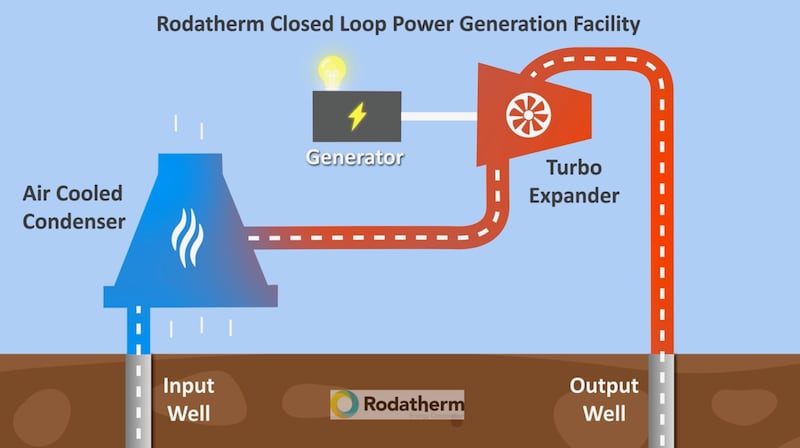
Utah is central to Rodatherm’s plan. Operating out of Salt Lake City and Calgary, the company is building toward a Utah pilot meant to prove commercial performance and unlock scaling. Cook has outlined a timeline to break ground in early 2026, complete an initial loop by late 2026, validate results under a secured offtake and then expand the site toward roughly 100 MW using project finance. If that sequence holds, Utah could add modular, water-light baseload power close to growing loads — exactly what grid planners and large customers are seeking.
“We love working in Utah. The people are fantastically nice,” Cook says. “Utah is open for business. What Gov. Spencer Cox has moved forward [with Project Gigawatt] is a huge vote of confidence for geothermal. Senate Bill 132 … streamlines bringing on production within the state. It all really lends itself wonderfully to developing significant projects within Utah.”
That combination — predictability plus efficiency potential — is what specifically drew VCs to write bigger checks for Utah-driven geothermal projects. It reframes geothermal from a bespoke geologic hunt into an engineered heat-transfer problem, with parts and processes that can be repeated from site to site.
The bottom line? VCs are more likely to invest in geothermal today because the market needs clean, 24/7 power, and the path to financing is more defined. Rodatherm’s “heat-pump-at-depth” approach aligns with that moment — tidy engineering, fewer variables and a clear Utah-first plan to prove it and scale.
“There’s a reason why we picked Salt Lake City and Utah as our hub,” Cook says. “Everyone’s efforts here are tied to Utah. We’re hiring in Utah. We are looking to build within Utah.”