

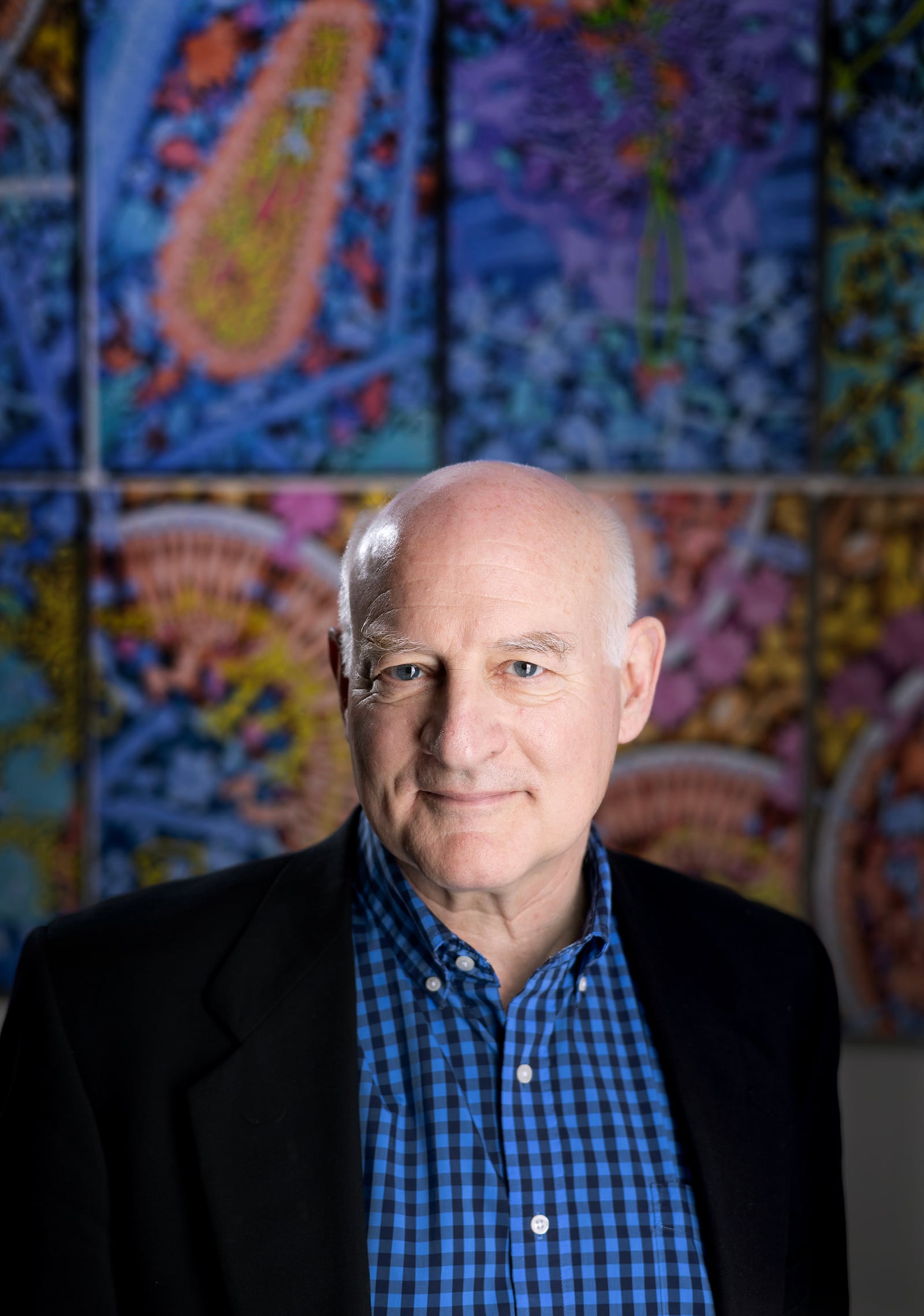
Wesley Sundquist
Samuels Professor & Co-Chair, Department of Biochemistry | University of Utah
A renowned scientist recognized among TIME’s 100 Most Influential People for his pivotal contributions to HIV drug development, Wesley Sundquist’s research on capsid proteins paved the way for lenacapavir — an HIV prevention drug with near-perfect efficacy in clinical trials.
Nola Sundquist, Chris Hill, Tomáš Cihlář, Gilead Sciences, President Taylor Randall and Magic Johnson. These names, along with countless research fellows, students, coworkers and community members, are the reasons we can celebrate the success of Wesley Sundquist, PhD.
“The person who is the PI (primary investigator) gets the awards for what everyone accomplished together,” Sundquist says. “If that doesn’t get conveyed, it’s — first of all — not fair to those folks, but also it’s not an accurate description of how it really works.”
In 2025, Sundquist was named one of TIME’s 100 Most Influential People in the world for his lab’s research that has now led to a highly effective HIV prevention drug. Sundquist and his teams began studying HIV in 1991, right after Magic Johnson announced his diagnosis. At the time, many other groups and labs had developed invaluable, life-saving research to treat HIV. Sundquist didn’t want to compete or “double up” on research, so he decided to focus on how the HIV particle, specifically the proteins in the capsid, was assembled.
“We [Sundquist and partner Chris Hill] came to realize that the architecture of the capsid was a structure which is called a fullerene cone,” he explains. “There was a short period of time when we tested it and … showed that the capsid is really important for the virus.”
With this new information, biopharmaceutical company Gilead Sciences developed lenacapavir.
“And in multiple clinical trials involving tens of thousands of people, lenacapavir has shown 99.9 to 100 percent efficacy in preventing HIV — results that Sundquist describes as ‘spectacularly successful,’” explained an April 2025 press release from the University of Utah.
While lenacapavir’s success is just getting started — the drug was approved for worldwide use in June 2025 — Sundquist’s groundbreaking research actually happened 20–30 years ago, early on in his lab’s lifetime. He’s now excited to see what researchers and drug developers can do with years’ worth of more recent research.
“I think every basic scientist wants their work to make an impact on real-world problems, but everyone has to understand that that takes time,” Sundquist says. “There was a lot of translation between understanding that the capsid is important and developing a drug and then clinically testing it to make sure it’s safe and effective. It’s been a little bit unusual in the sense that there was this long delay where really good people were working hard, but we were less involved than when we started.”
To fellow researchers, Sundquist advises taking satisfaction in what you do every day. Discovery research takes time and dedication, so working on projects that feel fulfilling in the moment is paramount.
To the wider business community, particularly in Utah, Sundquist applauds the long-term approach to investments and emphasizes the need for continued basic research.
“We need to take the long view. We must have people who are translating discoveries. Utah’s biotech sector does that really well, and that’s a great aspect of working in this environment,” he says. “But we also have to be willing to invest in the long-term future and understand how things work. NIH funding is in jeopardy. Next year, it won’t be a disaster, but three years from now, we’ll really be feeling it. In 15 years, it’ll mean we’re not saving lives.”