
This story appears in the March 2026 issue of Utah Business. Subscribe.
There is a place at the base of a mountain where horses heal and hope lives.
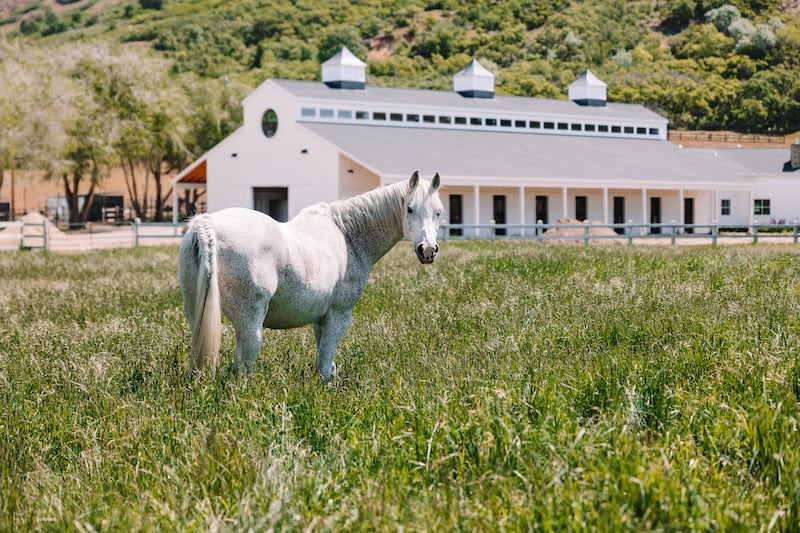
Everything about this pretty white barn in Alpine conveys an aura of serenity and peace — the calm quiet, the distinctive scent, the cozy white couches in cozy little nooks, the pink cowboy boots on display, the “7 Habits for Equestrians” framed on the walls. Even on a day when you drive through a sideways wind with icy graupel tap-tap-tapping across your windshield, you turn onto the crunchy gravel road beneath a sheer mountain lost in a furious cloud of wind and snow, and you find shelter from the storm.
“There’s a feeling here that you can’t quite describe, especially when I was lost and not really seeing my value in life,” says Sarah Richardson, a sixth-year instructor at Bridle Up Hope who is now expansion director. “You want to be here just because it seems so safe, and you feel seen immediately. This place saved me.”
Since its founding in 2012, Bridle Up Hope has tapped the healing power of horses to create a place for girls who couldn’t get out of bed through the darkness of depression; who were paralyzed by anxiety and couldn’t go to school; or who experienced devastating tragedy in their lives
Its women’s program came along in 2018 when mothers saw the impact on their daughters and asked if there was a similar program for them. The women’s program grew quickly; in 2025, women made up 46% of Bridle Up Hope program participants. All instruction is one-on-one. The program serves women in the depths of post-partum depression, mothers groping for purpose after the last child leaves the nest or, in Executive Director Nicole Holgreen’s case, a working mother of two whose unexpected divorce “brought me to my knees.”
Holgreen worked at a mortgage company — “heels and skirts, not jeans and boots,” she says — and had no particular interest in horses. In her first lesson at Bridle Up Hope, learning to walk a horse around a round pen, her instructor, Cindy, quietly watched her.
“Can I point out a few things with body language here?” Cindy asked.
She told Holgreen that when a horse, a herd animal, comes into an interaction, “They’re trying to decide: Are you the leader or am I the leader? Are you the one in charge, or am I the one in charge?”
Cindy taught Holgreen how to stand taller and command respect and how to set boundaries so the horse knew who was in charge. Soon enough, the horse was following Holgreen around the pen.
And then, Holgreen recalls, Cindy turned around and said, “How are you doing this in your life? How are you setting boundaries?”
“It was remarkable because at that moment in my life, I had walls up like Fort Knox,” Holgreen says. “At a mortgage company, you don’t take a mental health day because you’re going through a divorce. You show up, you put on a happy face, and you do your thing. I was so present in that moment because I was so focused on the horse.”

Sean and Rebecca Covey founded Bridle Up Hope as a foundation honoring their daughter Rachel, a vibrant personality who experienced depression and took her own life in 2012 at the age of 21. Her obituary read: “She had this uncanny ability to show up in people’s lives at their lowest point and through her accepting and loving ways, lift them to a higher plane. She did the same with animals, often nurturing neglected horses back to health.”
After Rachel’s funeral, one friend after another approached Sean and Rebecca and explained how, when they were going through a rough patch, Rachel would persuade them to join her at the barn to muck stalls and ride horses. Caring for horses helped them forget their troubles.
Sean recalls, “We just said, OK, we’re going to do what Rachel did and try to help young women who are struggling through horses.”
Today, Bridle Up Hope has 13 locations, including barns in Mapleton, Kaysville and St. George, Utah, and three international locations, including a barn in Chernihiv, Ukraine. Women complete a seven-week program that combines working with horses and life skills using the book “The 7 Habits of Highly Effective People,” written by Sean’s father, Stephen Covey, while the 14-week program for girls uses Sean’s book, “The 7 Habits of Highly Effective Teens.”
So many stories about this barn conjure an almost mystical quality — broken hearts and battered souls finding their way to this picturesque piece of land that sits below Smooth Canyon and Box Elder Peak.
One day, not long after Rachel’s passing, Sean and Rebecca were riding their four-wheelers and found themselves on this property at the end of Watkins Lane. David Pierce, whose family owned this mountainside farmland since 1854, hurried out to let the strangers know that they were trespassing on private property.
“Would you ever consider selling this land?” Sean asked him.
“No,” Pierce said. “This is a family property that has been passed down generation to generation.”
Pierce asked them their names, and Sean and Rebecca introduced themselves. In an instant, Pierce’s tone changed.
“Your name is Sean Covey,” Pierce said. “I have your name written on a Post-it note.”
Sean asked why, and Pierce said he had multiple dreams telling him to sell the property to the Coveys’ foundation.
The Coveys bought the initial land, and then a few years later, after witnessing the impact Bridle Up Hope was having, Pierce and his wife Kathryn donated 118.7 acres of mountainside to the foundation. Today, there are 19 horses in the stables, and riding trails weave their way up Smooth Canyon. Work has begun on an international training center, critical to the foundation’s audacious goal of growing to 1,000 barns around the world.
Resilience, one step at a time
The demand for mental health programming continues to grow. According to a 2023 survey by the Centers for Disease Control, 53% of high school girls reported persistent feelings of sadness or hopelessness, and 13% reported seriously considering suicide.
“I found Bridle Up Hope during a time that I thought my life was over and didn’t have any hope,” 14-year-old Addi said in the speech she delivered at the end of her program. “When we took the tour, I knew this was a place that was full of peace and second chances.”
Addi was struggling with debilitating depression, anxiety and suicidal thoughts when her mother, desperate for help, found the barn in Alpine. Addi had never been around horses before.

“While I got to learn to ride, I also learned to keep my anxiety intact because an anxious person can make an anxious horse,” she said. “In fact, I never felt anxious when I was with these horses and was most at peace with them. … I usually have a hard time looking back on my life because it reminds me of the hard times, but I’m so grateful that during this period of my life, I get to look back and feel proud that I worked at something every week and felt like I had a purpose again.”
Addi credits her instructor, Richardson, for helping her to find strength and realize “how beautiful life can be.”
“Obviously,” Richardson says, “we don’t take away depression, neither do the horses — but they do teach you how to be resilient, how to find your voice, how to find courage. Little by little, this young girl recognized: I can get out of bed. I can make my bed today. I can choose to go downstairs and eat a meal. … She was a student I saw a lot of myself in — going through hardships and maybe at times not seeing your self-worth and how amazing you are. I think a lot of young women struggle with that.”
The mission expands
One way women learn about Bridle Up Hope’s mission is through volunteer service projects that employers can organize at the barn. Inevitably, Holgreen says, an employee will reach out.
“They always say, ‘I never thought I would need this, but my wife lost her mom and she’s grieving like I’ve never seen,’” Holgreen says. “She needs hope.”
Holgreen’s first experience with Bridle Up Hope came through a women’s pilot program during her divorce. The staff saw something in her, so when a new program director position came up, they asked if she’d be interested. It would have been a 70% pay cut from her mortgage job, and with a divorce pending, she needed financial self-sufficiency more than ever. She declined several times.
Then Sean Covey called her and said, “Would you go for a walk with me?” The barn wasn’t built yet, and she remembers walking the property in her four-inch heels. Covey described the impact Bridle Up Hope was making and the need for a leader to take it to the next level.
“My friends told me I shouldn’t be making decisions like that right now,” Holgreen says, “but I feel like I was divinely led. I really feel like there was a peace about it, a complete calmness. I remember sitting on the front porch of that little building right there, looking out over the pasture and thinking, ‘How in the world did I end up here?’”
Under her leadership, Bridle Up Hope has served more than 3,500 girls and women, and in 2025, 98% of program participants rated it a “life-changing experience.”
“We don’t take away the struggle,” Holgreen says. “Some of our foster girls still go back home to a really hard time in life, and for others, depression is not removed. But they have been given the tools to navigate it.”
Sponsors and donors sustain the mission of Bridle Up Hope, Holgreen says, and while most students pay program fees (depending on location, $1,000 to $2,400 for women and $1,700 to $3,000 for girls), there is always a need for scholarship funding. Notable Utah family foundations have sponsored facility build-outs; walk the property, and you’ll pass the Miller Outdoor Arena, the Sorenson Legacy Foundation Arena, the Lolie Eccles Equine Center and the Bouchard Chocolate Round Pen.

Most locations are responsible for raising their own funds, but the location in Chernihiv, Ukraine, opened in 2023, is one exception. Holgreen admits she was skeptical about expanding into an active war zone, thinking Ukraine had bigger issues to worry about, like food and shelter. Then came another of those mystical coincidences.
Janis Lindley runs the Mapleton barn and, with her husband Corey, supported efforts by Healing Hands International to get food and therapists into areas in Ukraine damaged by Russian missiles. One day, she followed up to see how the women and girls were doing in therapy.
Unaware of Lindley’s barn, the Ukrainian man overseeing the effort replied, “You know, it’s the weirdest thing. There’s a barn on the other side of the property, and the horses gather along the fence lines. We have this building where the therapists work with the women and girls; they like to line up along the fence to see the horses. It’s hard to get the girls to talk to the therapists. I feel like the horses are doing more therapy than the therapists.”
To which Lindley said, “You’ve got to talk to the Covey family.”
As conversations evolved, Rebecca Covey asked Holgreen to join a call and urged her to keep an open mind. Holgreen says she’ll never forget what Natalia Furnikova, now the location’s horse director, said on that phone call: “Food will get us through the week, and shelter will get us through the winter, but what the women and people of Ukraine need right now is hope, and you have hope.”
And so the mission grew.
“Two weeks ago,” Holgreen says, “they had a graduation we Zoomed into, and they had to evacuate for drone attacks. They ended up finishing their graduation in shelters.”
Richardson adds, “Seeing everything they’re going through, we constantly say my life is not as hard as I make it seem because seeing this, the resilience they have, it changes your perspective on everything.”
It is late afternoon, and the winter storm in Alpine has cleared. As an instructor teaches a new student to trot in the indoor arena, and a program alumna cleans a stable to earn credit toward a free riding lesson, Holgreen is concluding a tour with a visitor.
She recounts how not long ago, she was on a similar walk around the grounds with David Pierce, whose home is adjacent to the family land that made Bridle Up Hope possible.
“I always knew this ground was sacred,” she remembers Pierce saying, “I just didn’t know why.”